Progress
Body Recomposition Before and After: How to See It
Body recomposition before and after photos often show the same weight with a different shape. What recomp is, who it suits, and how to document progress.
On this page 10 sections
- What is body recomposition?
- Who body recomposition works best for
- How to lose fat and gain muscle at the same time
- How long does body recomposition take?
- Body recomposition for women
- How to tell if your body is recomping
- How to document body recomposition progress
- What a recomp before and after actually looks like
- Common body recomposition mistakes
- FAQ
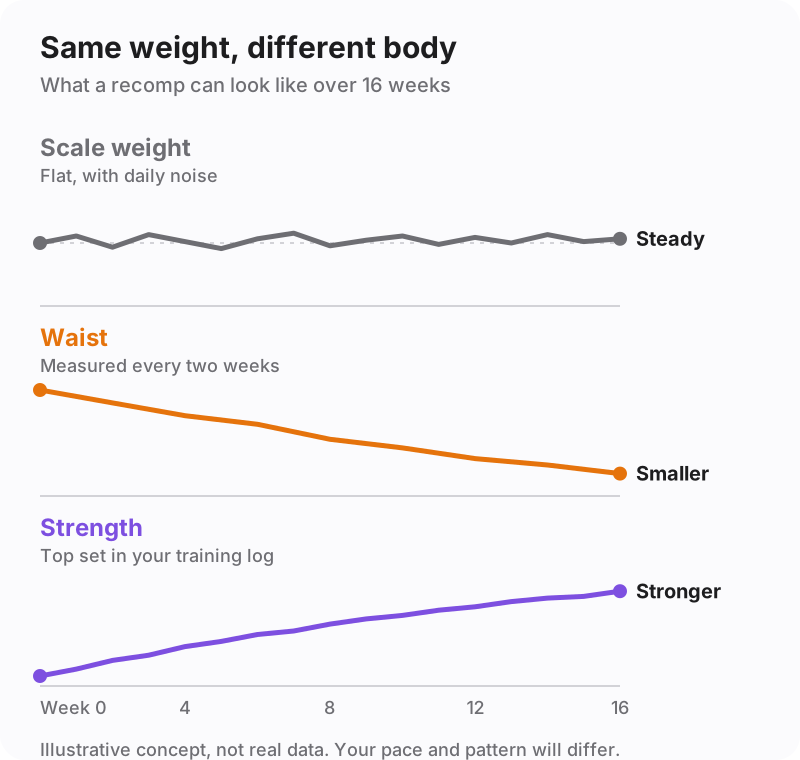
A body recomposition before and after usually looks strange on paper: the scale says almost nothing happened, yet the photos show a smaller waist, more defined shoulders and arms, and clothes that fit differently. That is the whole point of a recomp. You are losing fat and building muscle at the same time, so the two changes partly cancel out on the scale while your shape keeps moving.
That makes recomposition the clearest case where bodyweight is the wrong scoreboard. If you want to see body recomp progress, you need tools that capture shape and performance: consistent progress photos every two to four weeks, a tape measure for your waist, and a training log that shows you getting stronger.
Key takeaways
- A recomp means losing fat and building muscle at the same time, so the scale often barely moves.
- Judge it by three signals that agree: a shrinking waist, rising lifts, and consistent photos.
- Visible change in photos usually takes about 8 to 16 weeks of consistent training.
- Take photos every 2 to 4 weeks with the same pose, distance and light, or subtle changes disappear.
What is body recomposition?
Body recomposition (often shortened to "recomp") means improving your body composition by gaining muscle and losing fat over the same period, instead of in separate bulking and cutting phases. A 2020 review in the Strength and Conditioning Journal by Barakat and colleagues defines it as building muscle and losing fat concomitantly (Barakat et al., 2020).
The important difference from ordinary weight loss is the goal. A diet aims to make the scale go down. A recomp aims to change what your body is made of. Your weight may drift down a little, stay flat, or even creep up slightly, and the recomp can still be working.
The chart below shows what that looks like day to day. Drag across it: daily weigh-ins bounce around by a couple of pounds, and after the first few weeks the trend flattens out, even though the waist keeps shrinking.
Illustrative data: eight weeks of daily weigh-ins starting at 171 lb. The trend dips about a pound in the first two weeks, then holds flat for the remaining six while the waist measurement keeps going down. In a recomp, a flat scale is expected, not a failure.
Recomp vs. cutting or bulking
| Approach | Calories | Main goal | The scale | Often suits |
|---|---|---|---|---|
| Cut | Clear deficit | Lose fat, keep muscle | Goes down | Mainly fat-loss goals |
| Bulk | Surplus | Build muscle, accept some fat | Goes up | Lean, trained lifters |
| Recomp | Maintenance or a small deficit | Build muscle and lose fat together | Barely moves | Beginners, returning lifters |
Is it better to cut or recomp? It depends on where you're starting and what you want. If you have a lot of fat to lose and want the scale to move, a dedicated cut is more direct. If you are newer to lifting, returning after a break, or you'd rather change your shape without big swings in weight, a recomp fits better.
Who body recomposition works best for
Recomp is easiest for:
- Beginners. A new training stimulus produces relatively fast early gains.
- Returning lifters. People who used to train regularly often regain muscle faster than they built it the first time.
- People with higher body fat. More stored energy makes it easier to build muscle while eating at or a bit below maintenance.
Trained lifters can recomp too. The Barakat review cites "a substantial amount of literature" showing it in resistance-trained people, driven by progressive resistance training and evidence-based nutrition. Expect slower, subtler changes, which makes careful documentation even more valuable.
How to lose fat and gain muscle at the same time
Losing fat and gaining muscle at once comes down to four levers you pull together for months: lift progressively, eat enough protein, keep calories at or a little below maintenance, and sleep. None of them is exotic. The hard part is doing all four consistently while the scale gives you almost no feedback.
- Lift 2 to 4 times a week. Train every major muscle group at least twice a week with compound lifts, and try to beat last time's weight or reps.
- Hit a daily protein target. Research puts the useful range around 1.6 g per kg of body weight a day, spread across your meals.
- Eat at maintenance or a small deficit. Aim for a scale trend that holds steady or drifts down slowly, not a crash diet.
- Sleep 7 or more hours. Short nights undermine training, recovery and appetite.
- Measure the right things. Waist, lifts and photos every few weeks, not the daily weigh-in.
Progressive resistance training
Lifting is the signal that tells your body to keep and build muscle. "Progressive" means it gets harder over time: more weight, more reps, or more sets on the same movements. The CDC's baseline for adults is at least two days a week of muscle-strengthening activity that works all major muscle groups (CDC); for building muscle, most recomp programs land at three or four sessions. Volume matters too: a meta-analysis by Schoenfeld and colleagues found a graded dose-response, with more weekly sets per muscle group producing more growth (Schoenfeld et al., 2017). In practice, that means a handful of hard sets per muscle per week to start, built up gradually as you recover well.
Build each session around a few compound lifts (a squat or leg press, a hinge such as a Romanian deadlift, a push such as a bench or overhead press, and a pull such as a row or pulldown), then add one or two smaller exercises. Stop most sets a rep or two short of failure, keep good form, and add weight once you hit the top of your rep range. A simple program you follow consistently for months beats a clever one you abandon after three weeks. Logging every session matters here, because a rising strength line is one of your best early signs that a recomp is working.
Enough protein
Protein supplies the raw material for new muscle. A large 2018 meta-analysis in the British Journal of Sports Medicine by Morton and colleagues, pooling 49 trials and 1,863 participants, found that gains in fat-free mass from resistance training leveled off at a total protein intake of about 1.6 grams per kilogram of body weight per day (Morton et al., 2018). For a 70 kg (154 lb) person, that's roughly 112 grams a day. Some research uses higher intakes during a deficit: a 2016 trial in young men eating far below maintenance found that 2.4 g/kg/day led to more lean mass gain and fat loss than 1.2 g/kg/day (Longland et al., 2016).
Maintenance or a modest deficit
A recomp works at or slightly below maintenance calories. Eat too far below and you make building muscle harder; eat well above and you are bulking. A small deficit also explains why the scale may barely move: a little fat goes, a little muscle arrives, and the net change is small.
You don't need a perfect calorie number. Track your intake loosely for two weeks, watch your weight trend, and adjust: if the trend is climbing and your waist is growing, trim portions a little; if you're losing weight quickly and your lifts are stalling, eat a bit more. A smoothed trend is far more useful than single weigh-ins here, which is what the water weight calculator's trend view is for.
Cardio and daily movement
Cardio isn't required for a recomp, but it helps your health and gives you a little more room in your calorie budget. The CDC recommends 150 minutes of moderate activity a week for adults. Walking is the easiest version to recover from; keep hard conditioning sessions away from your heaviest leg days so they don't eat into your lifting.
Sleep and consistency
The Barakat review lists sleep among the non-training factors that influence recomposition. The CDC recommends that adults aged 18 to 60 get 7 or more hours of sleep a night (CDC). Sleep is also where a lot of recomp attempts quietly fall apart, because short nights make training worse and appetite harder to manage.
How long does body recomposition take?
Expect strength gains in the first month, a waist measurement that moves in about one to two months, and visible change in photos after roughly two to four months of consistent training. It's slower than a cut. Step through a realistic picture for someone training consistently:
Strength first
Lifts climb quickly, mostly as you learn the movements. Photos look about the same, and the scale jumps around with water and food. Take your baseline photos and measurements now; you will want them later.
The tape starts to move
Small changes may show in your waist measurement and in how clothes fit. Side-by-side photos may hint at a difference, but only if they are well matched in pose, distance and light.
Photos catch up
This is often where a body recomp before and after becomes visible: a different waist-to-shoulder shape, more definition in the arms and shoulders, a posture that looks more confident.
Slower, still real
Changes continue but slow down, especially for experienced lifters. Comparing against your first session matters more than comparing last month to this month.
Your pace will depend on training history, starting body fat, age, sleep, stress and consistency. For more on what's realistic over different time spans, see our body transformation timeline.
Body recomposition for women
Body recomposition for women follows the same principles: progressive lifting, enough protein, calories near maintenance and good sleep. Women build muscle more slowly in absolute terms, but relative to their starting point they respond to resistance training much like men. A meta-analysis by Roberts, Nuckols and Krieger found similar gains in muscle size and lower-body strength between the sexes on the same programs, and larger relative gains in upper-body strength for women (Roberts et al., 2020). Lifting heavy won't make you bulky overnight; muscle gain is slow for everyone, and a recomp is about shape.
What's different:
- The scale is noisier. Many women see weight run higher in the days around their period, mostly from water. Compare the same phase of your cycle month to month, or rely on a smoothed trend; the water weight calculator shows how much a cycle can move the scale.
- Change often shows in the lower body and waist first. Fuller glutes and shoulders, a more defined waist, and jeans that fit differently at the same weight are common recomp signs. Back and side photos catch this better than front photos alone.
- The numbers sit higher. Women carry more essential fat, so a fit, healthy body fat percentage is several points higher than a man's. See body fat percentage pictures for what different ranges look like.
- Life stages matter. Pregnancy, postpartum and perimenopause all change body composition, sleep and recovery. Lifting is generally a good fit for each, but check with your clinician about what's right for you.
Protein targets are the same per kilogram of body weight, which works out to fewer grams a day for a smaller body: about 96 grams for a 60 kg (132 lb) woman at 1.6 g/kg.
How to tell if your body is recomping
Because the scale can't tell you, look for several signals that agree with each other:
- Your waist is shrinking while your weight holds steady. This is the single most useful number in a recomp.
- Your lifts are going up. More reps or more weight at the same bodyweight is a strong sign you're adding muscle.
- Clothes fit differently. Looser at the waist, tighter across the shoulders, back or thighs.
- Your photos change shape. Compare photos taken weeks apart with the same pose, distance and light.
If the scale is stuck and none of these are moving either, it may be a stall rather than a recomp. Our guide to the weight loss plateau covers how to tell the difference.
How to document body recomposition progress
Good documentation is what turns "I think something's changing" into a body recomposition before and after you can trust. You need three things.
- Progress photos every 2 to 4 weeks. Same poses, same spot, same distance, same light, same time of day.
- Waist measurements on photo day. Same tape, same spot on your waist, after a normal exhale.
- A strength log every session. Exercise, weight, sets and reps, so week 12 can be compared with week 1.
1. Progress photos every 2 to 4 weeks
Weekly photos mostly show noise. Every two to four weeks gives your body time to change visibly while keeping enough data points to see a trend. Keep everything else the same:
- Same poses: front relaxed, side and back at a minimum. Flexed poses help show muscle that a relaxed pose hides.
- Same setup: camera at about chest-to-navel height, same distance, same spot, same light.
- Same conditions: same time of day (mornings work well), same clothes, before eating or training.
For the full setup, read how to take progress photos, and for a pose checklist see our progress photo poses guide.
2. Waist and hip measurements
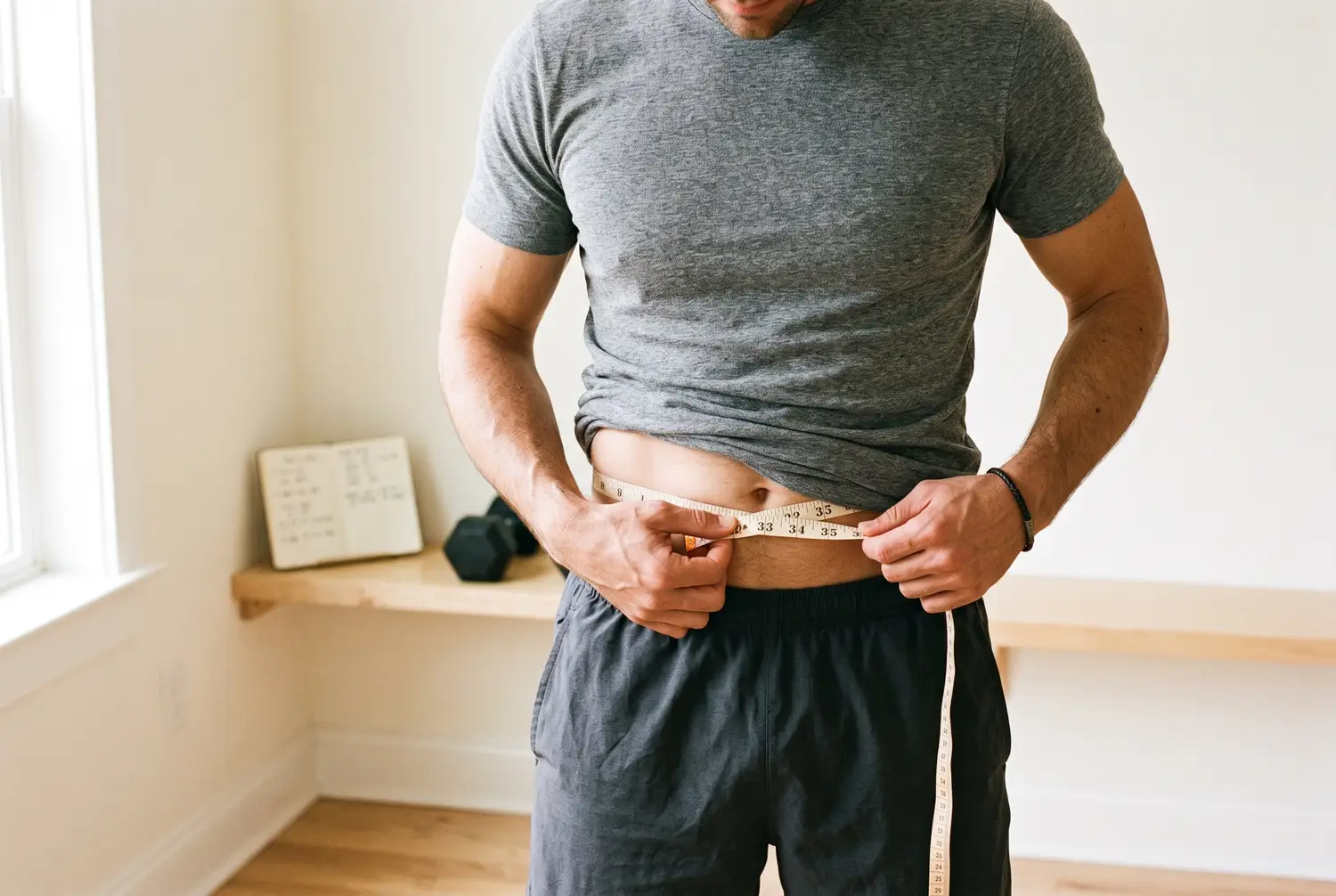
Measure on the same day as your photos, at the same time, with a flexible tape. For the waist, stay consistent about where you measure (at the navel or at the narrowest point; pick one) and measure after a normal exhale. Take two readings and use the average. A centimeter here or there is normal noise; look for the direction over a couple of months. If you also track hips, the waist-to-hip ratio calculator turns both numbers into one trend.
3. A strength log
Write down the exercise, weight, sets and reps for every session. You don't need anything fancy. What matters is that you can look back at week 1 and see that the same weight now moves for more reps.
Weigh in, but don't let it lead
Keep tracking bodyweight if you like. It adds useful context: a flat weight alongside a shrinking waist is the signature of a recomp. Just don't use it as your verdict.
What a recomp before and after actually looks like
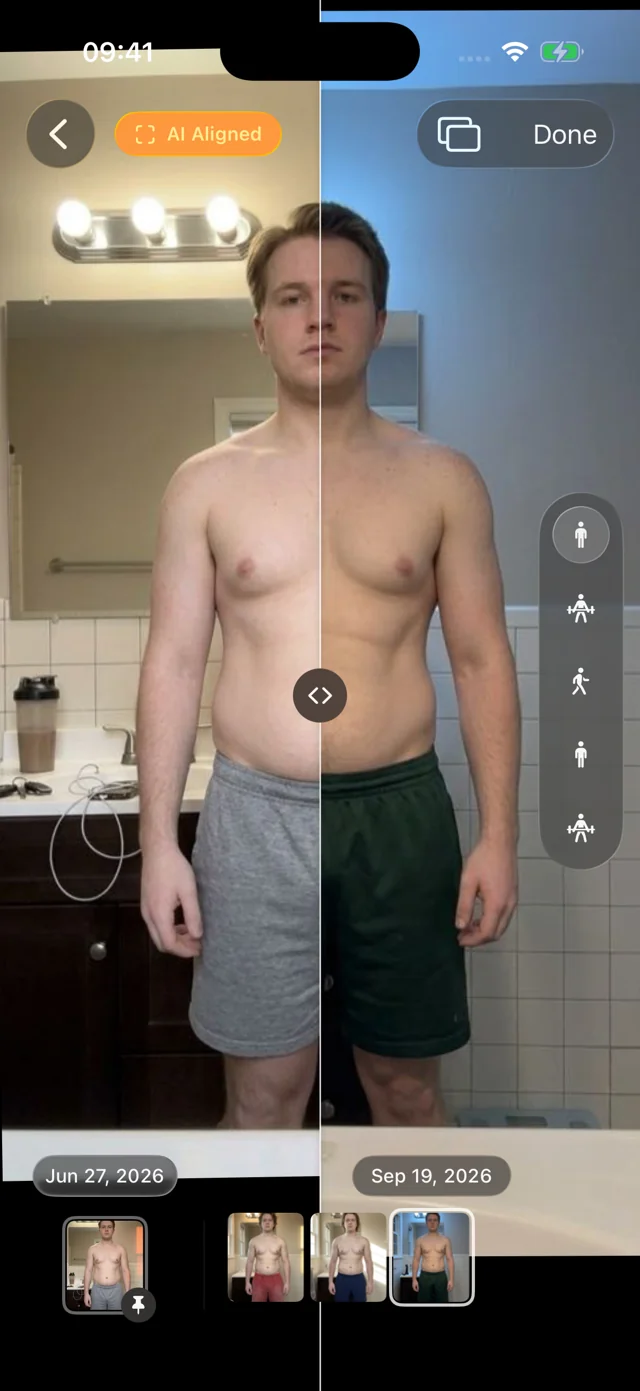
Most dramatic transformation photos you see online are cuts, where the person is simply much lighter. Recomp before and afters are quieter: a narrower waist relative to the shoulders, more visible separation in the arms and shoulders, a flatter midsection, and fuller glutes or legs. Scrub through sixteen weekly sessions below and watch the shoulders and arms fill out while the midsection tightens.
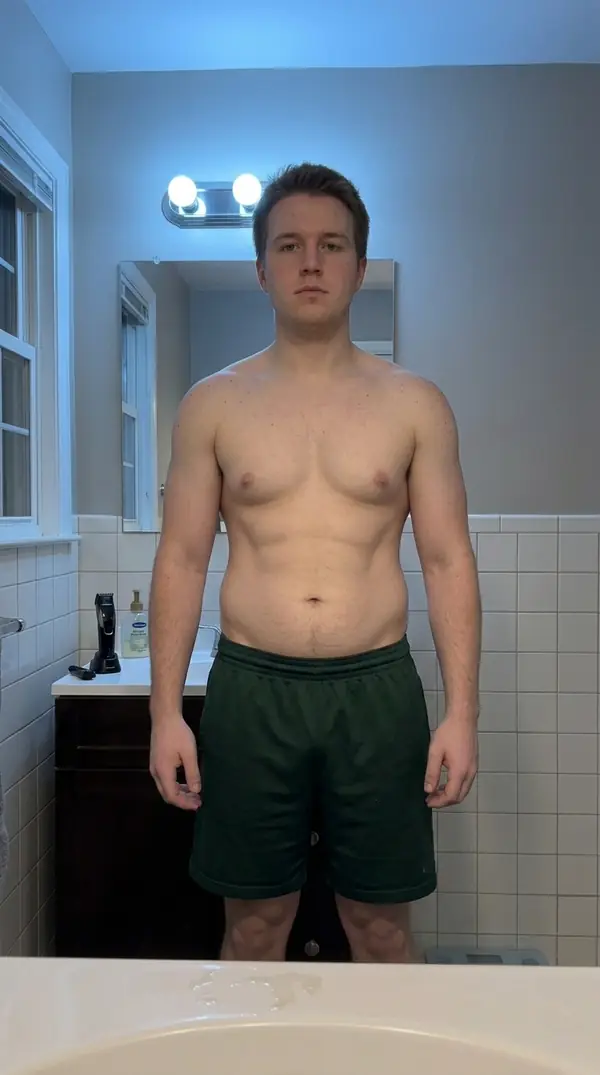
Those differences are subtle enough that framing can erase them. Step a foot closer to the camera, tilt the phone, or shoot in a different room, and a real change can disappear, or an imagined one can appear.
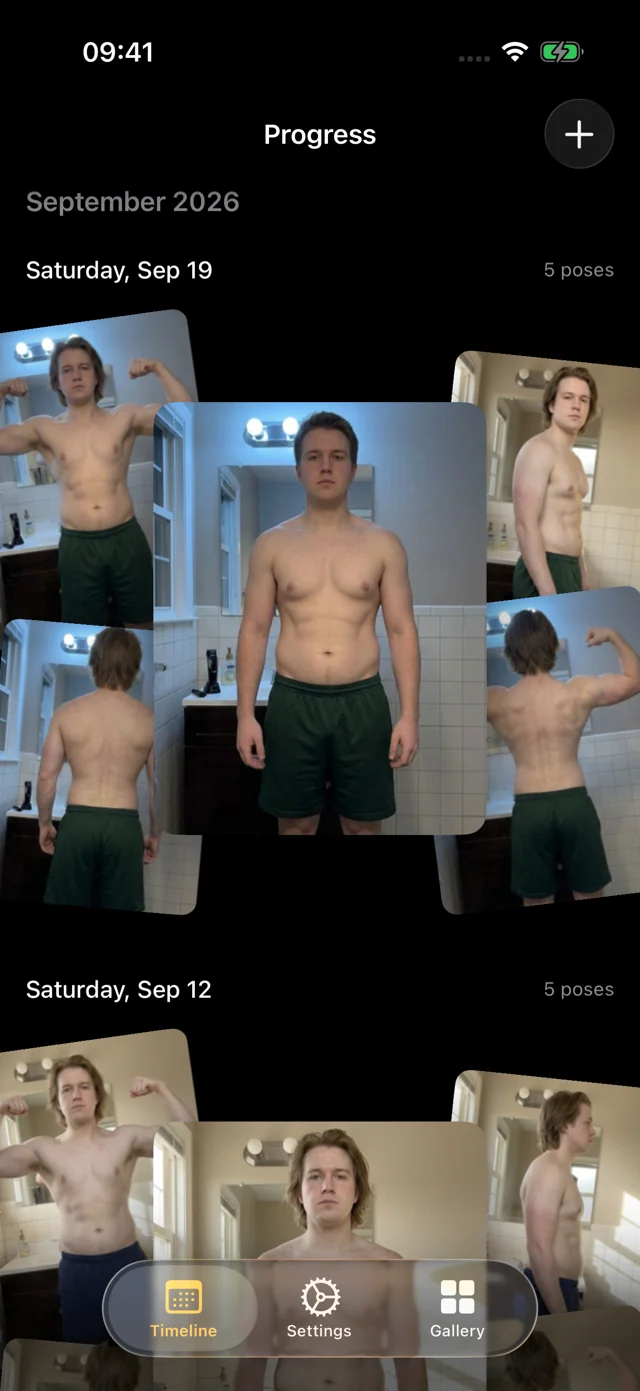
Progress is built for this. Every photo is AI aligned on your iPhone, so week 1 and week 16 line up and the only thing that changes is you. You can slide a divider across two aligned dates, or pin your first session as a reference and scrub through everything since. Hands-free capture walks you through the same five poses (front relaxed, front flexed, right side, back relaxed, back flexed) in about a minute, and you can log weight alongside each session. There's no account, and your photos stay on your device. If you already have months of recomp photos in your camera roll, you can import them and Progress will line those up too.
For more on making fair comparisons, see our guide to before and after photos.
Common body recomposition mistakes
- Judging by the scale. The most common reason people quit a recomp that was working.
- Changing the program constantly. Progressive overload needs the same lifts long enough to progress.
- Eating too little. A big deficit makes building muscle harder and training feel worse.
- Under-eating protein. One of the easiest gaps to close.
- Inconsistent photos. Different light, distance or pose can hide months of change.
- Checking too often. Daily mirror checks and weekly photo comparisons mostly show noise.
FAQ
How do you lose fat and gain muscle at the same time?
Lift weights progressively two to four times a week, eat around 1.6 g of protein per kilogram of body weight a day, keep calories at maintenance or a small deficit, and sleep seven or more hours. It works best for beginners, people returning to training and people with more body fat to lose, and it takes months rather than weeks.
How long does body recomp take?
Many people notice strength gains within the first month, but visible changes in photos usually take around 8 to 16 weeks of consistent training, adequate protein and sleep. Experienced lifters should expect slower changes than beginners or people returning after a break.
Is it better to cut or body recomp?
Neither is better for everyone. A cut moves the scale faster and suits people focused on fat loss. A recomp suits beginners, returning lifters and people who want to change shape without big swings in weight. If you have health conditions, talk to a clinician or registered dietitian first.
Can women do body recomposition?
Yes. Women respond to resistance training with similar relative gains in muscle size as men. The same principles apply: progressive lifting, enough protein, calories near maintenance and good sleep. Expect the scale to swing more around your cycle, and judge progress by your waist, lifts and photos.
How do I know if I'm recomping if the scale isn't moving?
Look for a shrinking waist at the same weight, rising numbers in your training log, clothes fitting differently, and visible change in consistent progress photos. If all of those are flat too, you may be stalled rather than recomping.
How often should I take body recomp progress photos?
Every two to four weeks is a good rhythm. It gives your body enough time to change between sessions while still showing a clear trend over a few months.