Progress
Body Fat Percentage Pictures: What Each Range Looks Like
Body fat percentage pictures for men and women, from very lean to 35%+: what each range typically looks like, why photos mislead, and how to measure it.
On this page 10 sections
- How to read body fat percentage pictures
- Body fat percentage pictures for men
- Body fat percentage pictures for women
- What does 15% body fat look like?
- Healthy body fat ranges and essential fat
- Women's body fat percentage: healthy ranges by age
- Why body fat pictures mislead
- How body fat is actually measured
- Track your own photos, not strangers'
- FAQ
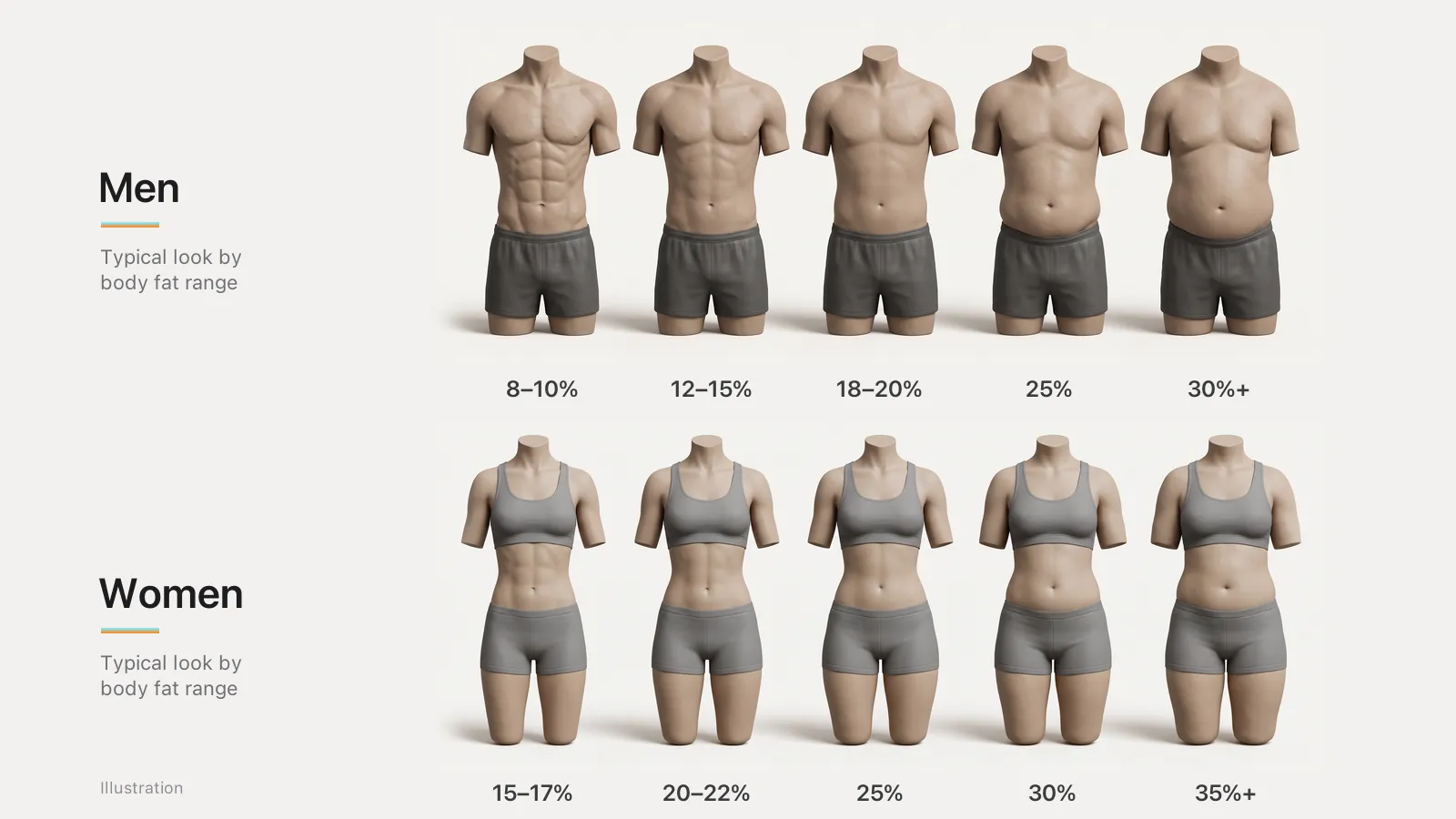
Body fat percentage pictures are useful as a rough map, not a measuring tool. For men, a visible six-pack usually shows up somewhere around 10–12%, a flat stomach with only faint upper abs around 15%, and a smooth midsection with little definition around 20%. Women carry more essential fat, so the same visual cues appear roughly 8–10 points higher: some ab outline around 16–20%, a defined waist without visible abs around 22–25%, and softer curves through the hips and stomach from about 30%.
Treat those numbers as rough. Two people at the same body fat can look very different, and the same person can look several "percent" leaner or softer depending on the light, the time of day and what they ate. Your own photos, taken the same way over time, tell you more than any stranger's.
Key takeaways
- Use body fat pictures to learn which features change (abs, waist, flanks, hips), not to diagnose yourself to the decimal.
- Women's visual landmarks sit about 8–10 points higher than men's because of essential fat.
- Lighting, a pump, water and posing can shift how lean you look more than a month of real progress.
- Every measurement method is an estimate. Pick one, repeat it the same way, and watch the trend.
- Your own consistent photos beat any chart of strangers for answering "is it working?"
How to read body fat percentage pictures
Every chart, including the illustrations on this page, lines up bodies by a single number. In reality, how lean someone looks depends on at least four other things:
- Where they store fat. Some people hold most of it around the stomach, others in the hips, thighs, arms or back.
- How much muscle they have. More muscle under the same layer of fat reads as "leaner" and more defined.
- Their frame. Shoulder width, rib cage, height and where the abdominal tendons sit all change the picture.
- The photo itself. Light direction, posture, a pump and water retention can move the apparent number more than a month of real progress.
The percentages on popular charts are also often unlabeled guesses rather than scan results, and the measurement methods disagree with each other by several points. Use the ranges below to understand which features change as body fat goes up or down. The illustrations keep the same build at every step so only body fat changes, which real bodies never do.
Body fat percentage pictures for men
Men tend to store fat first around the lower belly, lower back and flanks ("love handles"), so the clearest visual signals are ab definition, the lower-belly contour, and how the waist compares with the chest and shoulders. Step through the ranges below; the shoulders stay the same, and the waist and flanks do the changing.
8–10%: what 10% body fat looks like
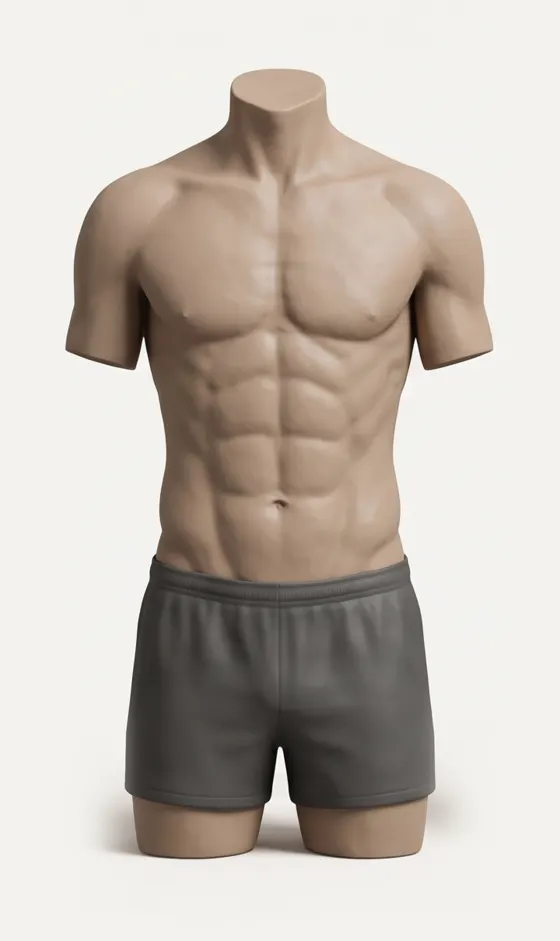
Most men show a clear six-pack outline in normal indoor light, visible separation along the obliques, and the "V" lines that run from the hip bones toward the groin. Veins may show on the forearms and lower stomach. The waist is noticeably narrower than the chest, which gives a strong V-taper from the front.
This is a lean, athletic level. Most people find it hard to hold year-round alongside normal life, sleep and appetite.
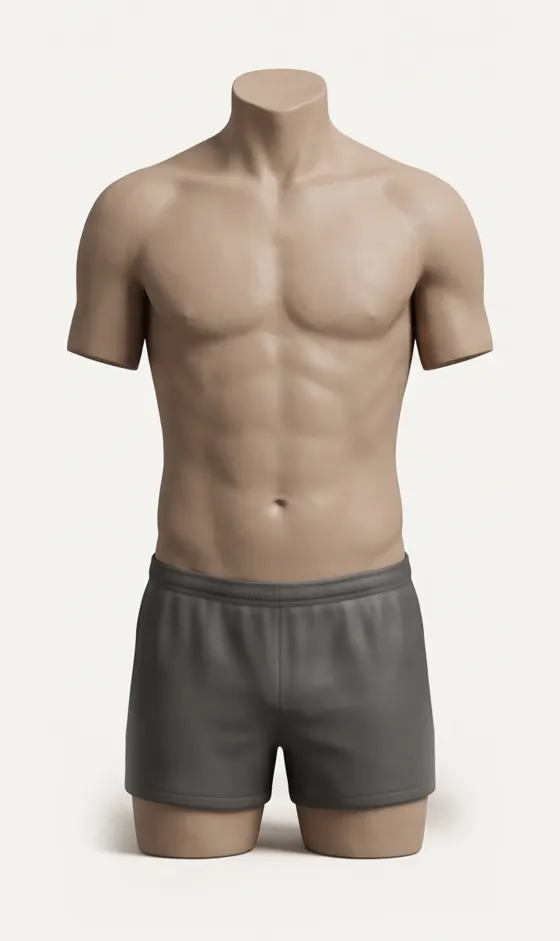
12–15%: what 15% body fat looks like
Around 12% the upper abs are usually still visible, with the lower abs fading. By about 15%, most men see a flat stomach, a faint vertical line down the center, and upper abs only under overhead light or when flexed. The chest has a defined lower edge, the arms look muscular rather than soft, and there's little fat at the hips. In a T-shirt, this is the "fit" look many people are aiming for.
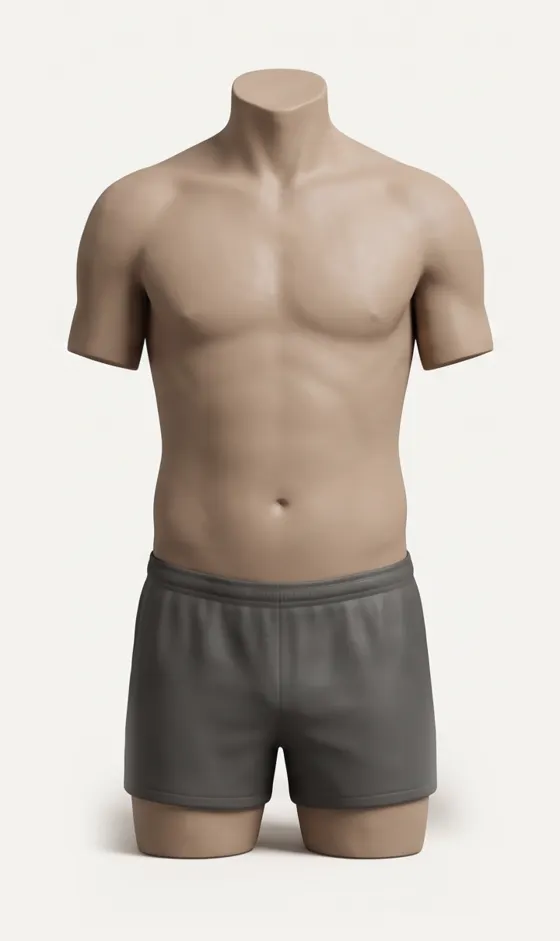
18–20%: what 20% body fat looks like
Abs are generally not visible in relaxed photos, apart from a faint outline in flattering light. The stomach is smooth and mostly flat when standing tall, with a slight curve below the navel. The waist is closer to the width of the chest, and some fat appears at the flanks and lower back. Muscle shape is still visible in the shoulders and arms, but edges are softer. Plenty of active, healthy men live here; it sits within ACE's "average" range.
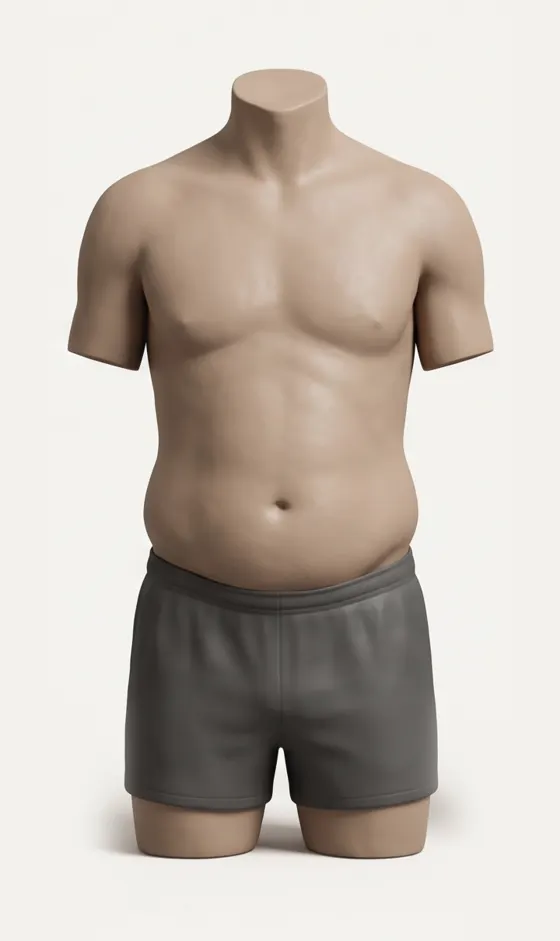
25%: a softer midsection
The lower belly rounds out and folds slightly over the waistband, the flanks are visible from the front, and the chest is softer with less defined edges. The face and neck often look fuller. ACE treats 25% as the point where men move out of the average range.
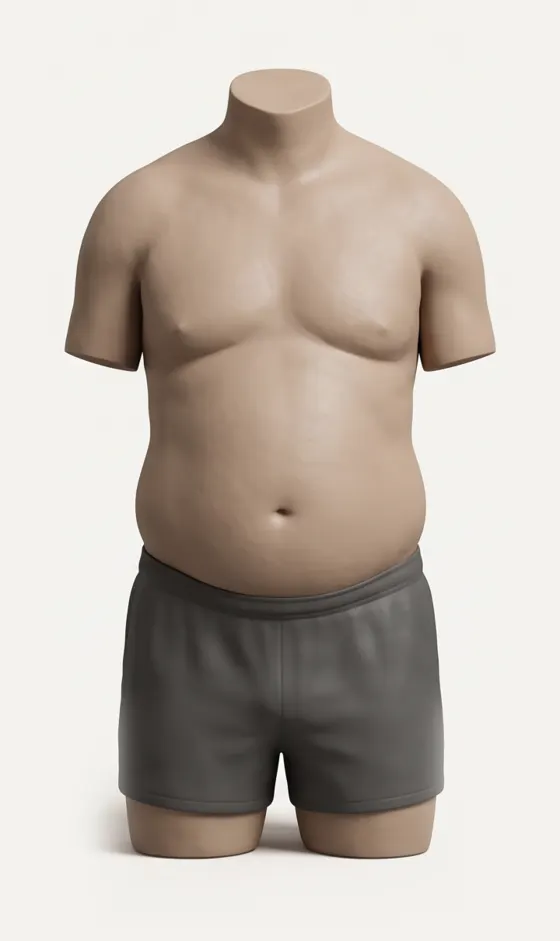
30% and above
The waist is usually wider than the chest from the front, the stomach protrudes in side photos, and fat is visible across the back, chest and upper arms. At this level, changes in a few weeks are often easiest to see in side and back photos and in how clothes fit, while the front view moves more slowly.
Body fat percentage pictures for women
Women's body fat percentage runs higher than men's at every level of fitness. Women have more essential fat, for hormonal and reproductive function, so every visual landmark shows up at a higher number. Many women also store proportionally more fat in the hips, thighs and buttocks, which means the stomach can look lean while the lower body changes slowly, or the reverse after pregnancy or around menopause.
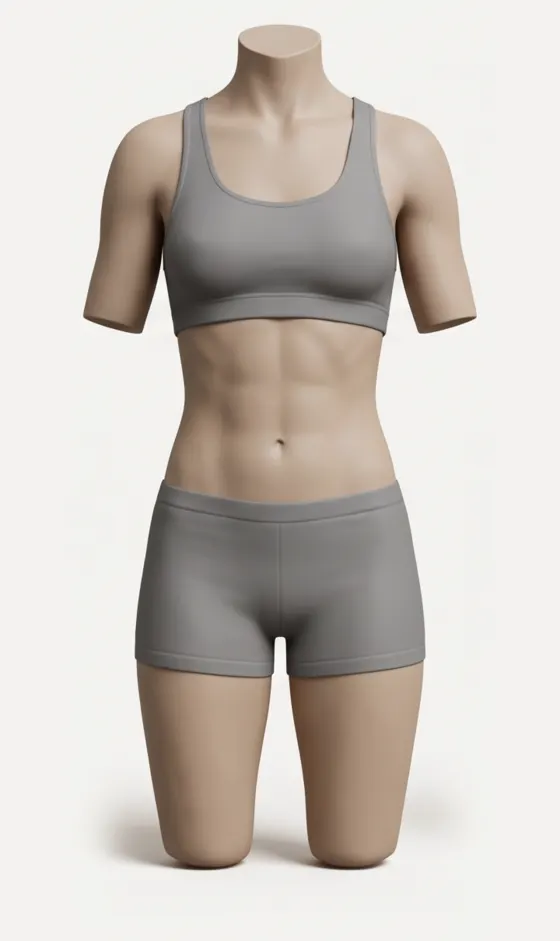
15–17%: very lean
This is very lean for a woman, typical of some competitive athletes and physique competitors. There's a visible outline of the upper abs, clear oblique lines, defined shoulders and arms, and visible separation in the legs. Hips and breasts are smaller than they would be at higher levels.
For many women, going this low can disrupt the menstrual cycle, so it isn't a sensible target without professional guidance.
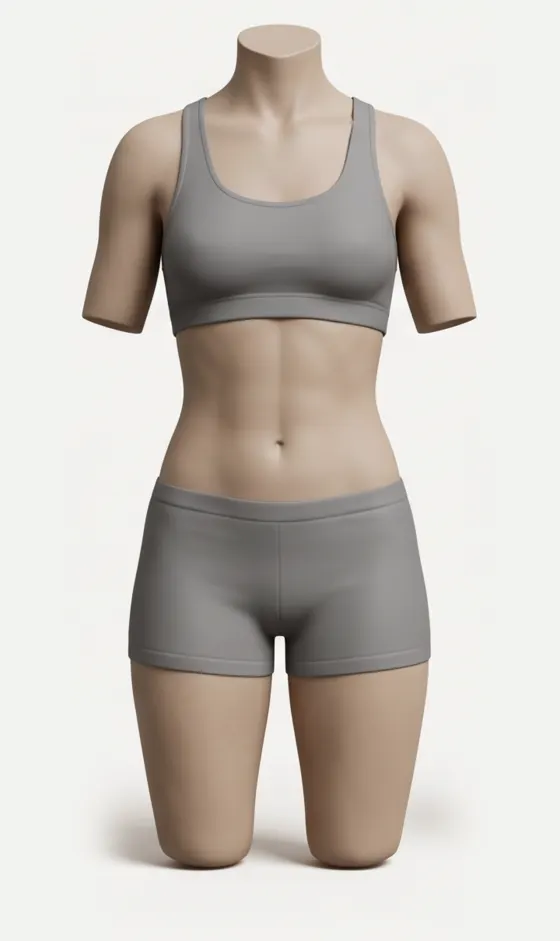
20–22%: what 20% body fat looks like for women
Most women show a flat stomach with a vertical center line, some definition in the arms and shoulders, and a clearly defined waist. The hips are rounder than at the leaner end, and the thighs may touch. This sits in ACE's "athletes" to "fitness" territory and is a common look for regular gym-goers and active women.
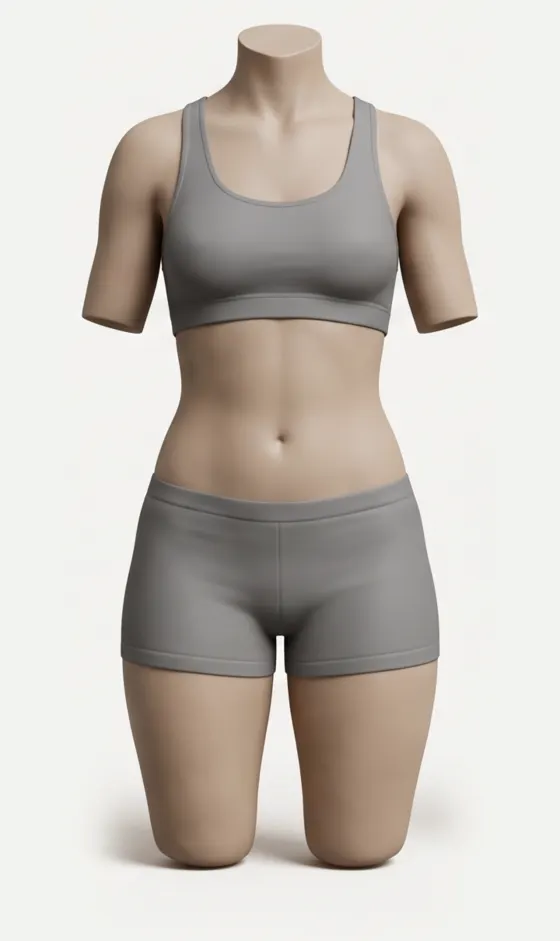
25%: smooth and fit
Abs aren't visible, the stomach is smooth and mostly flat, the waist is still clearly narrower than the hips, and there's more fullness in the hips, thighs and buttocks. Many women would describe this as healthy and fit; it's the bottom of ACE's "average" range.
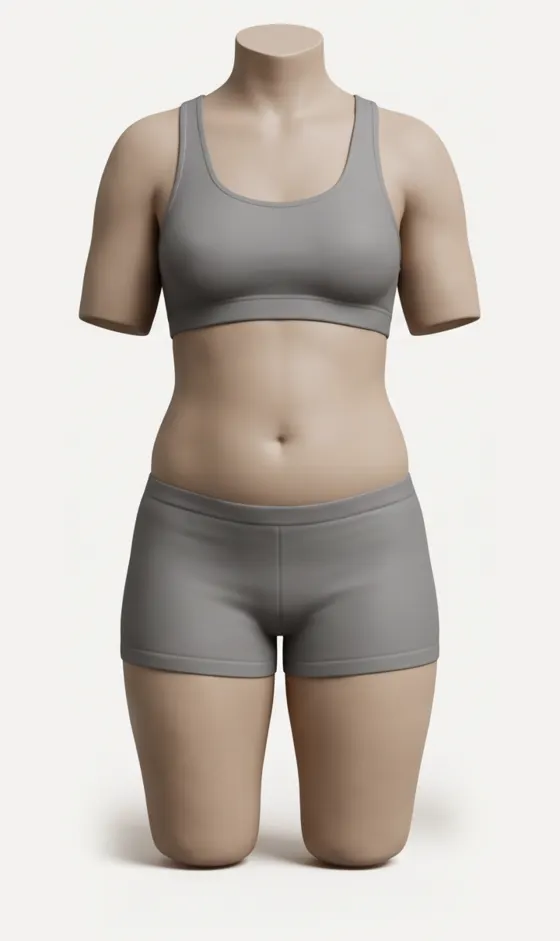
30%: softer lower belly
The lower belly is softer and may curve outward slightly, the waist-to-hip difference is a bit smaller, and there's more fat on the upper arms, thighs and back. This is within the average range for women and is very common.
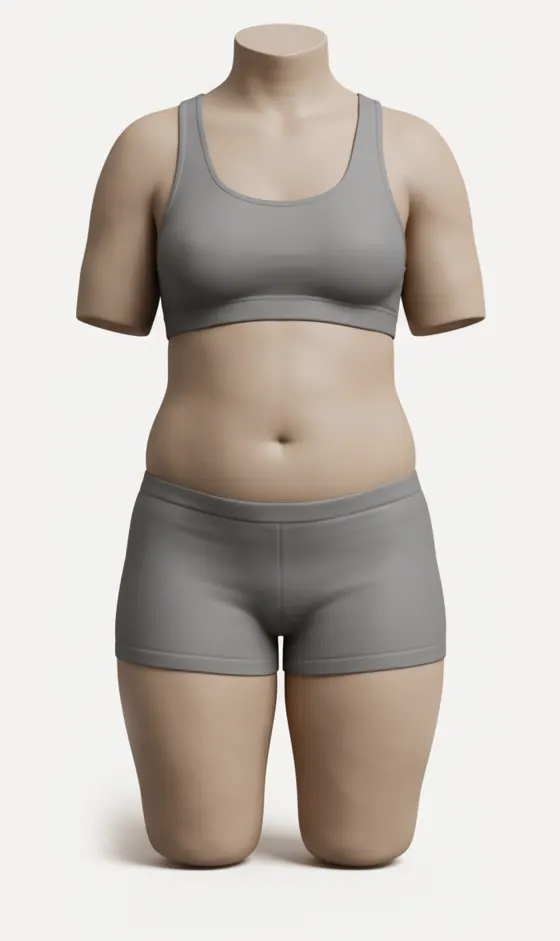
35% and above
From the mid-30s, the waist tends to straighten, the stomach protrudes in side photos, and fat is distributed more evenly across the arms, back, hips and thighs. Fat in the upper body and around the middle becomes more noticeable, and the face is fuller.
What does 15% body fat look like?
15% body fat is one of the most searched numbers because it looks so different for men and women. On a man, 15% body fat is the classic lean, "fit in a T-shirt" look. On a woman, 15% is close to the floor of what's healthy, the territory of physique competitors on stage.
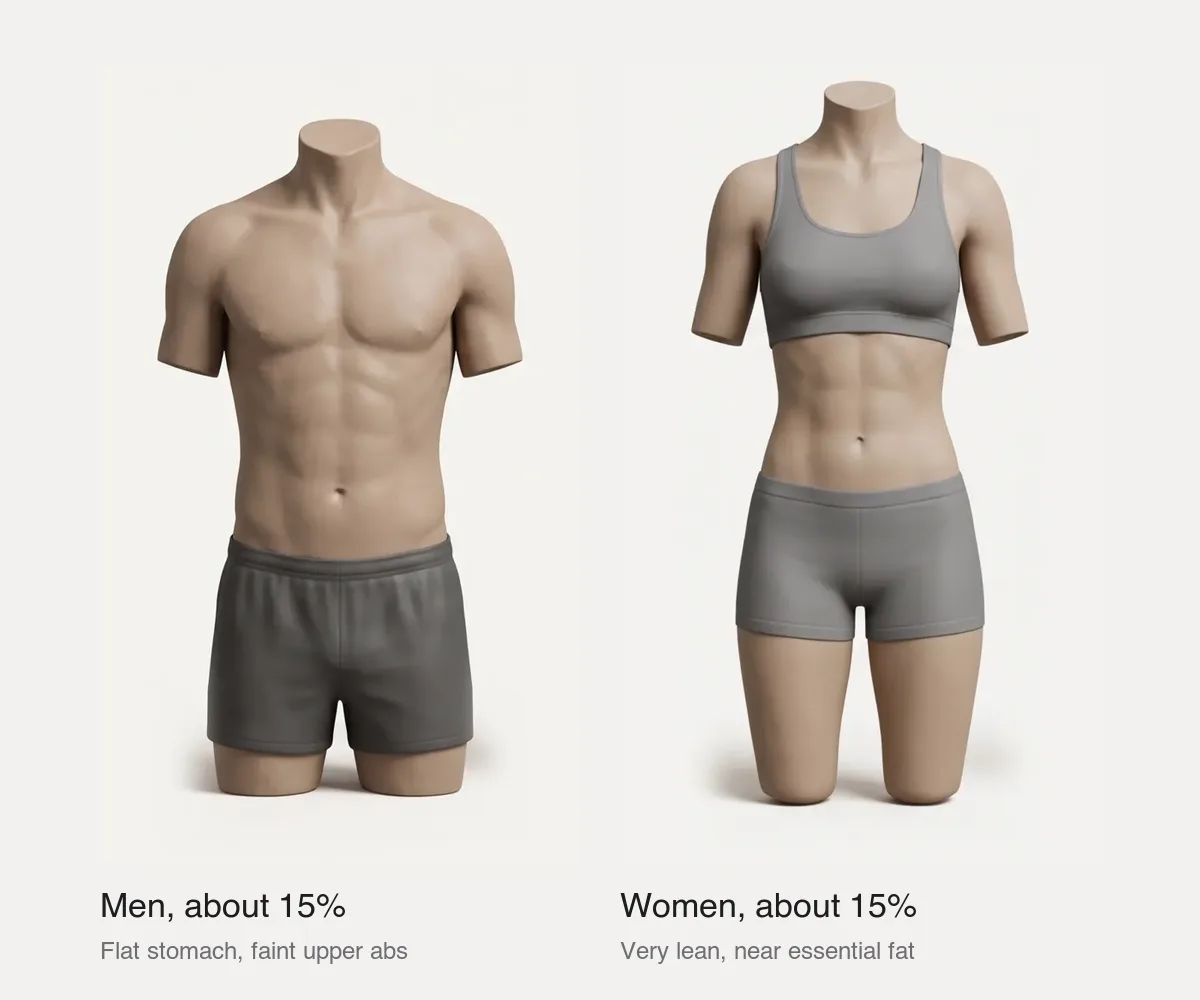
Male 15% body fat
For men, 15% sits at the top of ACE's "fitness" range (14–17%). Typical signs:
- A flat stomach in relaxed photos, with a faint vertical line down the center.
- Upper abs visible under overhead light or when flexed; lower abs usually smooth.
- A visible lower edge to the chest and some separation in the shoulders and arms.
- Little fat at the flanks, so the waist is clearly narrower than the chest.
It's a level many men can hold year-round with regular training and reasonable eating, unlike 8–10%. If you're around 20% now, the change to 15% shows up most in the lower belly and love handles, so side photos usually reveal it before the front ones do.
15% body fat for women
For women, 15% is just above ACE's essential fat range (10–13%) and inside the "athletes" category (14–20%). It usually means visible abs, clear muscle separation in the shoulders, arms and legs, and smaller hips and breasts than at higher levels. Many women can't reach or hold it without disrupting their menstrual cycle, so it's an athletic extreme, not a general goal. The healthier comparison for most women is the 20–25% range in the illustrations above.
Healthy body fat ranges and essential fat
The most widely used reference chart comes from the American Council on Exercise (ACE). It's a set of categories, not a medical diagnosis, and it doesn't adjust for age (body fat tends to rise with age even at a stable weight).
| Category | Women | Men |
|---|---|---|
| Essential fat | 10–13% | 2–5% |
| Athletes | 14–20% | 6–13% |
| Fitness | 21–24% | 14–17% |
| Average | 25–31% | 18–24% |
| Obese | 32%+ | 25%+ |
Source: American Council on Exercise body fat percentage norms.
Essential fat is the minimum the body needs for normal function: it's part of nerves, cell membranes, bone marrow and organs, and in women it supports reproductive hormones. Pushing toward that floor is not a fitness goal.
Women's body fat percentage: healthy ranges by age
A healthy women's body fat percentage is a range, and it creeps up with age. The ACE chart above doesn't adjust for age; for that, use a study by Gallagher and colleagues in the American Journal of Clinical Nutrition. They measured body fat with reference methods in 1,626 adults and worked out which body fat levels line up with the standard BMI cutoffs (Gallagher et al., 2000). For African American and white women, that gives:
| Age | Healthy range | Overweight-equivalent | Obesity-equivalent |
|---|---|---|---|
| 20–39 | about 21–32% | 33% and up | 39% and up |
| 40–59 | about 23–33% | 34% and up | 40% and up |
| 60–79 | about 24–35% | 36% and up | 42% and up |
Source: Gallagher et al., 2000, Table 4. The lower end corresponds to a BMI of 18.5 and the overweight line to a BMI of 25. For men the same table gives roughly 8–19% (20–39), 11–21% (40–59) and 13–24% (60–79).
How to read it:
- Age shifts the range by a few points. At the same BMI, older adults tend to carry more fat, so the overweight-equivalent line moves from 33% for women in their 20s and 30s to 36% for women in their 60s and 70s.
- Ethnicity matters too. The same study found Asian women had higher body fat at the same BMI, about 25–34% across the healthy BMI range for ages 20–39.
- These ranges are provisional. They map body fat to BMI cutoffs, not to where health risk begins. Use the table to see where you sit, not as a pass or fail.
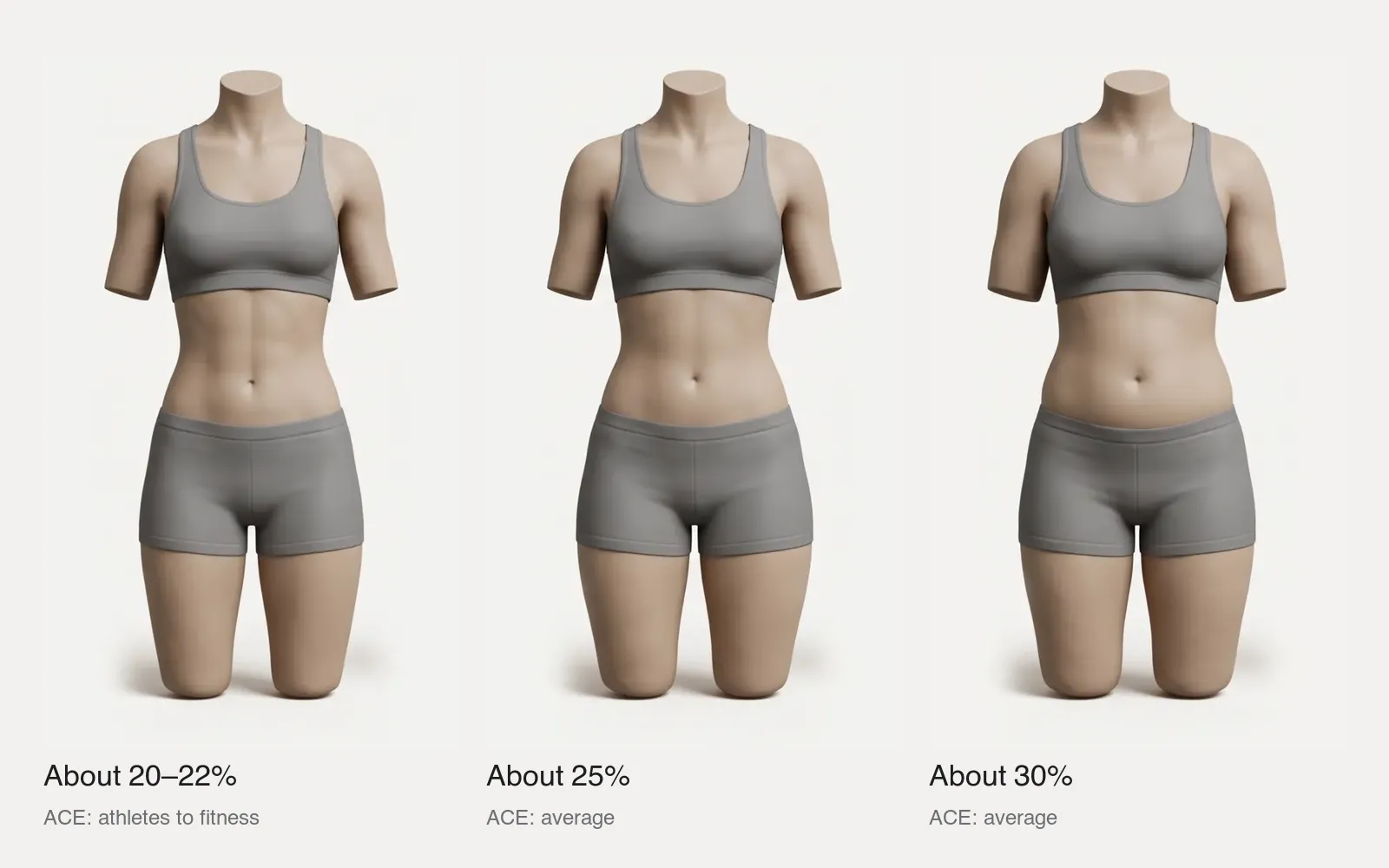
Put together with ACE, most women between roughly 20% and the low 30s are within a healthy range, with the upper end more typical later in life. Below about 14%, you're into essential fat, and periods, bone health and energy can suffer. If you're unsure where a number puts you, a clinician can read it alongside your waist size, blood pressure and blood work.
Why body fat pictures mislead
Even an honest photo of a real person with a DEXA-verified number is a single moment. Lighting alone can make the same body look like a different range:
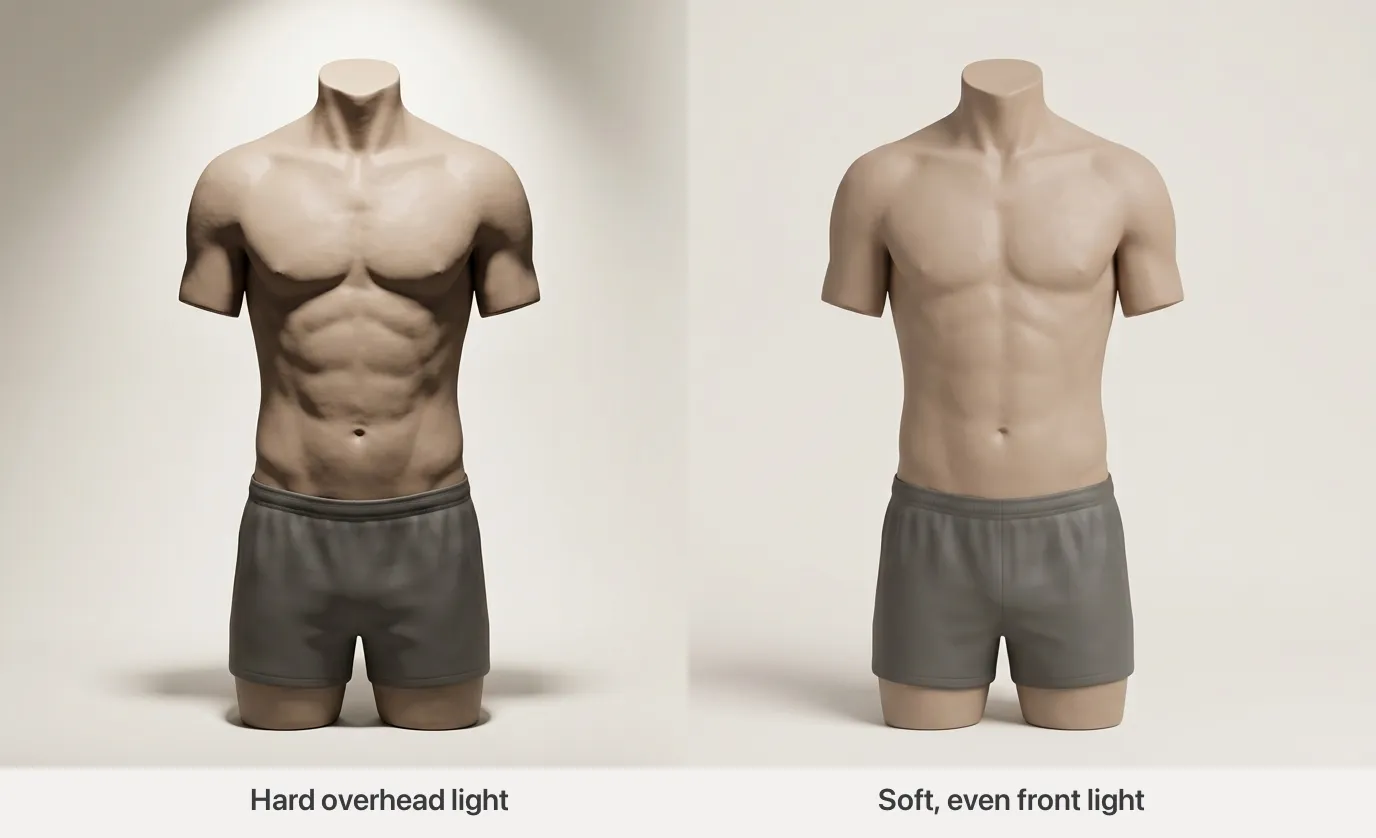
These are the most common ways the same body looks different from shot to shot:
- Lighting. Hard light from directly above casts shadows under every ridge and can make abs look deep. Soft, even light from the front flattens everything and can make you look several points softer.
- The pump. Right after a workout, muscles hold more fluid and blood and look bigger and harder, which makes the fat over them look thinner.
- Water and food. A salty dinner, a high-carb day, alcohol, travel, poor sleep and the menstrual cycle can all add visible water and bloating. Morning, before eating, is when most people look most consistent.
- Posture and posing. Standing tall, flexing, a slight vacuum of the stomach and turning a few degrees toward the camera all change the silhouette. Most influencer photos are posed to flatter.
- Camera distance and lens. A phone close to your body distorts proportions; the same phone eight feet away doesn't. Shooting from above or below changes how wide your waist looks.
- Genetics and fat distribution. Some people show abs at higher body fat because their abdominal fat is thin or their ab muscles are thick; others never see a full six-pack even when lean.
The conditions of the photo matter as much as the body in it. Keep them the same and your own photos become a fair comparison. The full setup is in our guide on how to take progress photos that actually show change.
How body fat is actually measured
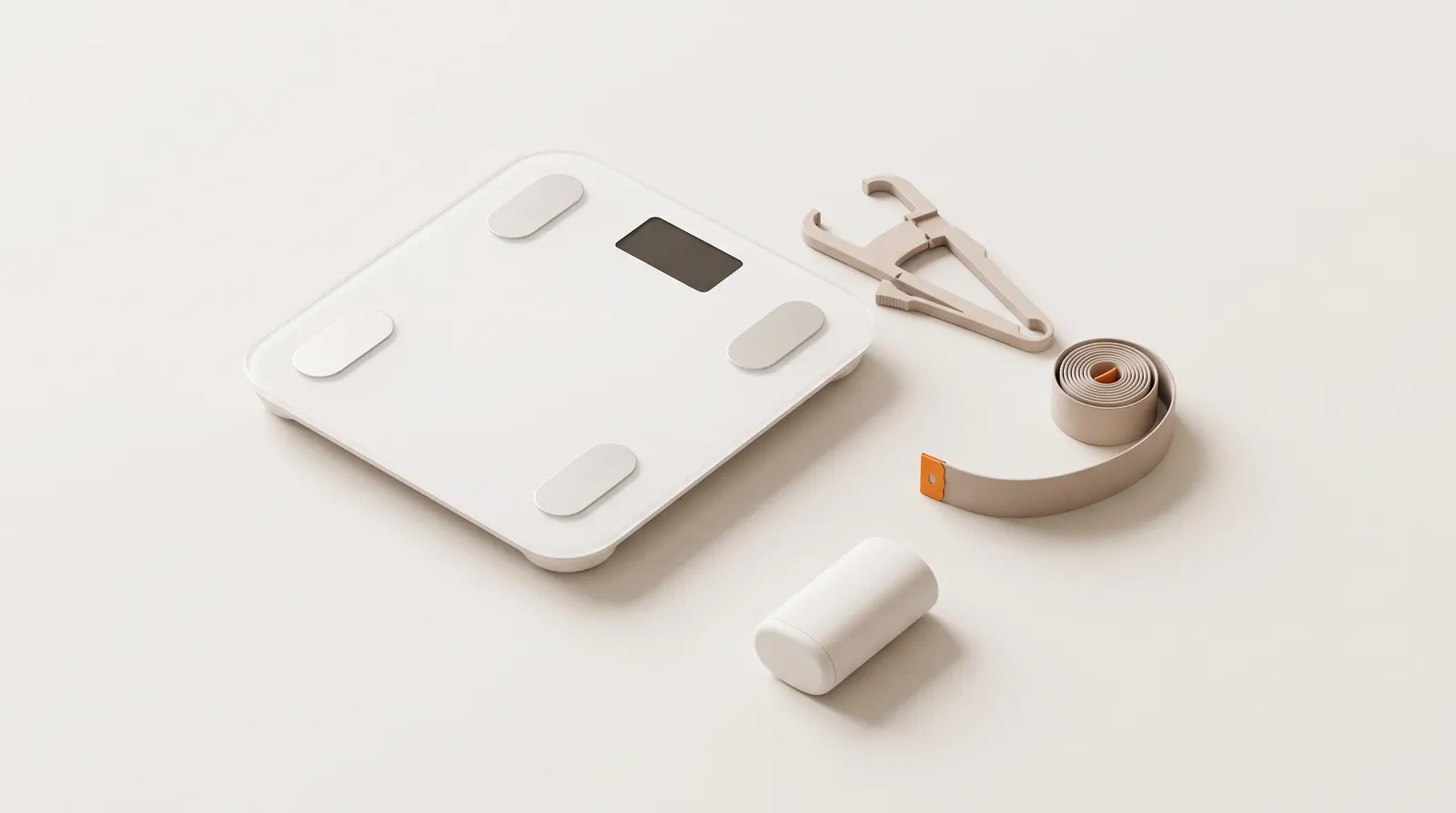
Every method estimates body fat from something else: X-ray absorption, electrical resistance, skinfold thickness or circumference. None is exact, and they disagree with each other, so the most useful habit is to pick one method and use it the same way every time.
| Method | Accuracy | At home | Good for trends | Watch out for |
|---|---|---|---|---|
| DEXA scan | Closest to a reference | Clinic or lab, paid | Same machine only | Machines and software disagree |
| Smart scale (BIA) | Single readings vary widely | Daily, cheap | Use weekly averages | Hydration, meals, time of day |
| Skinfold calipers | Depends on the tester | Low cost | Same sites, same tester | Hitting the exact same spot |
| Navy tape method | Fine on average, off for individuals | Free, a tape measure | Same spots, same time | Can be many points off DEXA |
| Visual estimate | A range at best | Photos or a mirror | Only with consistent photos | Light, pose, fat distribution |
What the research shows:
- Bioelectrical impedance (BIA) is accurate under controlled clinical conditions, but a review in the Nutrition Journal found its performance in the field inconsistent, influenced by factors such as environment, ethnicity, menstrual cycle phase and medical conditions (Dehghan & Merchant, 2008). ACE notes that dehydration in particular can make BIA overestimate body fat (ACE).
- Tape measurements: a 2024 study in Military Medicine comparing the circumference method with DEXA found a small average error in women (about 1.7 points), but individual results ranged from roughly 14 points under to 11 points over (Military Medicine). Averages can look fine while any one person's number is far off.
- Calipers: ACE points out that it's hard to measure at the exact same spot each time, which reduces accuracy; averaging three measurements per site helps.
So a "15%" label on someone else's picture could have come from any of these methods, on any day. Treat any single reading as a rough estimate and watch the trend.
Track your own photos, not strangers'
A chart of strangers answers "roughly where am I?" Your own photos, taken the same way every week or two, answer a better question: "is it working?" Your genetics, fat distribution and frame are the same in every frame, so the change you see is real change.
To make your own pictures trustworthy, tick these off before every session:
- Same place, same light. One spot with even front light, every time. Avoid overhead spotlights.
- Same time, same state. Morning, after the bathroom, before food or training.
- Same distance and height. Phone on a stand or shelf at about chest height, the same distance away, on a timer. No mirror selfies.
- Same poses. Relaxed front, side and back at minimum; compare relaxed with relaxed.
- Compare far apart. Four, eight or twelve weeks ago, not yesterday. Day-to-day noise is bigger than weekly progress.
Our guide to progress photo poses walks through a standard set, and the same rules apply if you're tracking GLP-1 progress photos or a 75 Hard challenge.
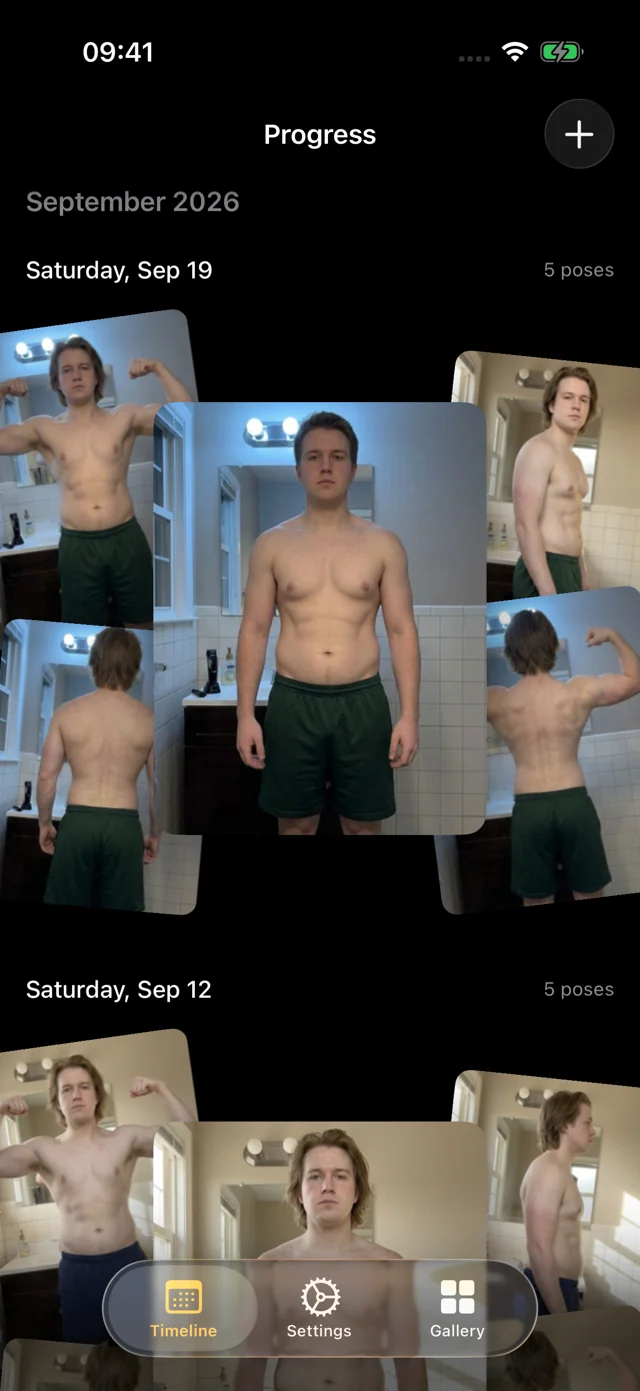
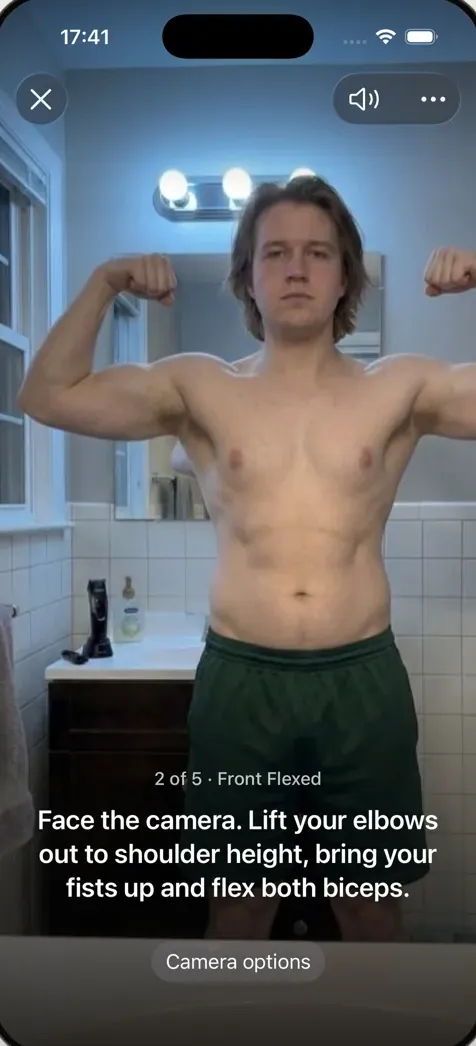
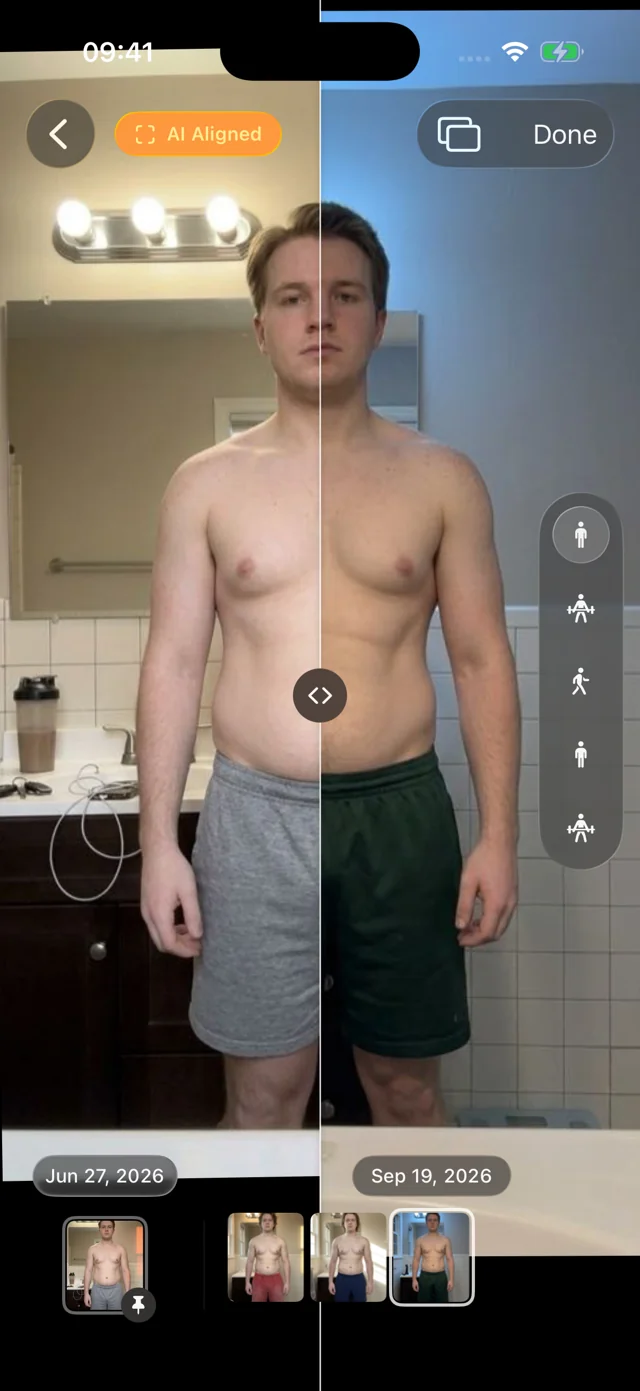
Progress is built for this. It doesn't estimate body fat; it takes the inconsistency out of the photos: hands-free capture walks you through five poses (front relaxed, front flexed, right side, back relaxed, back flexed) while your phone sits on a shelf, and every photo is AI aligned on your iPhone so you can slide a divider between any two dates. Your photos stay on your device.
If your scale stalls while your photos and waist keep changing, you may be building muscle and losing fat at once; see what body recomposition looks like in before and after photos, or our guide to breaking through a weight loss plateau.
FAQ
How do I tell my body fat percentage visually?
Compare your relaxed front and side photos, in soft front light, against the descriptions above. Look at ab definition, the lower-belly contour, and your waist width relative to your chest (men) or hips (women). Aim for a range, not a number, and expect to be off by a few points in either direction. For a measured number, a DEXA scan, or one consistent method repeated over time, is more reliable.
Is 30% body fat a lot?
It depends on sex. For women, 30% sits within ACE's "average" range (25–31%). For men, 30% is above the 25% point where ACE's "obese" category begins. Body fat is only one part of health, though; waist size, fitness, blood pressure and blood work matter too, and a clinician can put your number in context.
What does 15% body fat look like?
For men, 15% usually means a flat stomach with a faint center line and upper abs visible under good light or when flexed. For women, 15% is very lean, close to essential fat, with visible upper abs and noticeable muscle definition. That's not a level most women can maintain comfortably.
What is a healthy body fat percentage for a woman?
Roughly 21–32% for women aged 20 to 39, rising to about 23–33% in their 40s and 50s and 24–35% from 60, based on the BMI-linked ranges from Gallagher and colleagues. ACE classes 21–24% as "fitness" and 25–31% as "average." Below about 14% is close to essential fat and isn't a healthy target for most women.
Are smart scale body fat readings accurate?
They're better for trends than for absolute numbers. Bathroom BIA scales are sensitive to hydration, meals, exercise and time of day, so a single reading can be several points off. Weigh in at the same time each morning and look at the weekly average.