Progress
75 Hard Progress Pictures: A Daily System That Works
How to take 75 Hard progress pictures you can actually compare: one fixed setup, the same poses, and day 1, 25, 50 and 75 checkpoints. Plus the rules, in brief.
On this page 8 sections
75 Hard asks for a progress picture every single day, and most people end up with 75 photos they can't really compare: different rooms, different light, the phone a little closer one day and tilted the next. Good 75 hard progress pictures come from deciding everything on day 1 and never changing it. Same spot, same time, same light, same poses, phone on a stand with a timer. Then, instead of flipping through all 75, you compare four checkpoints: day 1, day 25, day 50 and day 75.
Key takeaways
- The rules only say "take a progress picture every day." Making the photos comparable is up to you.
- Lock the spot, time, light, clothes, poses and phone position on day 1, and never change them.
- Compare checkpoints (day 1, 25, 50, 75), not consecutive days. Daily differences are mostly water and light.
- Line photos up at the same scale before you judge them, and compare like pose to like pose.
- 75 Hard has no rest days and an all-or-nothing restart rule. Check with a clinician if you have health concerns.
The 75 Hard rules, in brief
75 HARD is a program created by Andy Frisella, who describes it as a mental toughness program rather than a fitness plan. "75 HARD" is his trademark; Progress isn't affiliated with or endorsed by him or his companies. The official rules list five daily tasks for 75 consecutive days:
| Daily task | What the rules say | Easy to get wrong |
|---|---|---|
 Diet Diet | A diet of your choosing that fits your goals. No alcohol, no cheat meals. | One “small” exception counts as a cheat meal. |
 Two workouts Two workouts | Two 45-minute workouts, at least three hours apart. One must be outdoors. | Back-to-back sessions, or both indoors. |
 Water Water | Drink a gallon of water every day. | Leaving most of it for late evening. |
 Reading Reading | Ten pages of a nonfiction, educational book. | Audiobooks don’t count. |
 Progress picture Progress picture | Take a progress picture every day. | Forgetting it at night, or taking 75 photos you can’t compare. |
The rule that defines the challenge: miss any task on any day and you start over at day 1. There are no substitutions.
What the progress picture rule actually requires
The rule is short: take a progress picture each day. It doesn't specify a pose, an outfit, a time of day or a camera. Frisella has also said the photos are for you and don't need to be posted (TODAY). That leaves the useful part, making the photos comparable, entirely up to you.
Get this part right. You see yourself in the mirror every day, and daily change is too small to notice. The photos are the only record that lets you look back at day 1 with fresh eyes on day 75.
A system for 75 Hard progress pictures you can compare
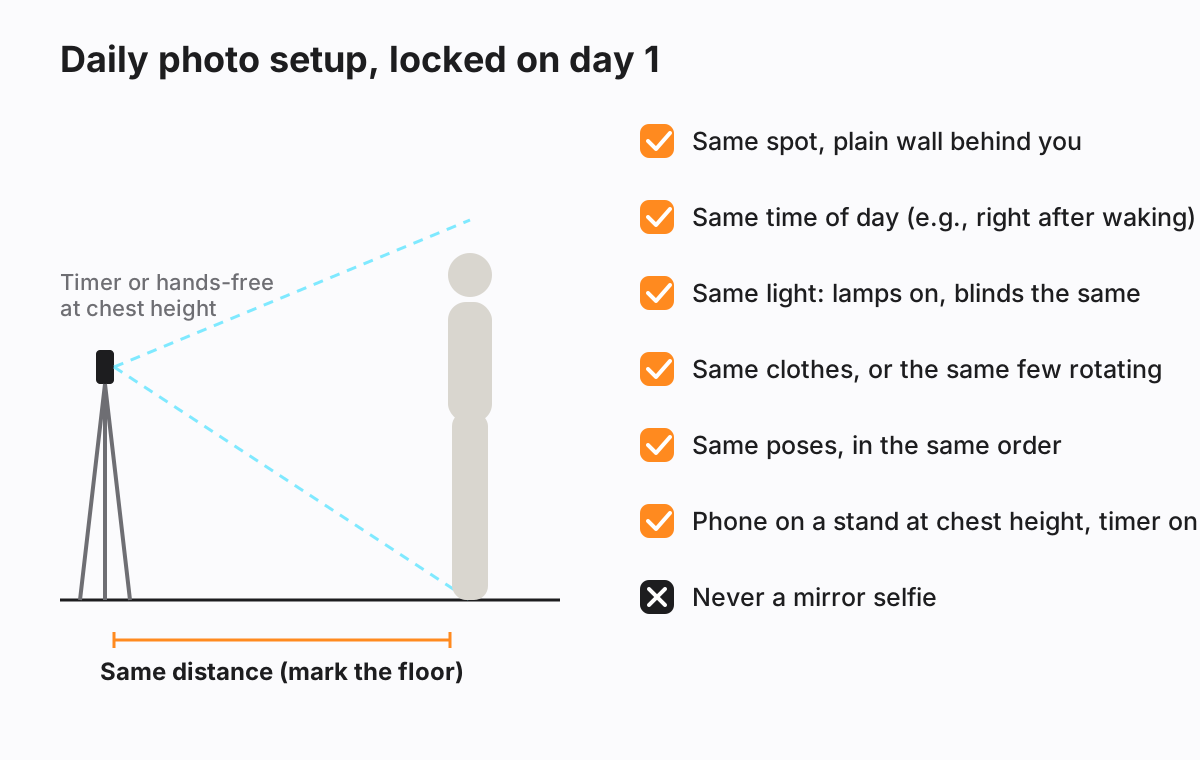
The goal is that the only thing that changes between photos is you. Every other variable gets locked on day 1. Start with where the phone goes: try the simulator below, then copy the height and distance that frame you head to feet.
Pick one spot and mark it
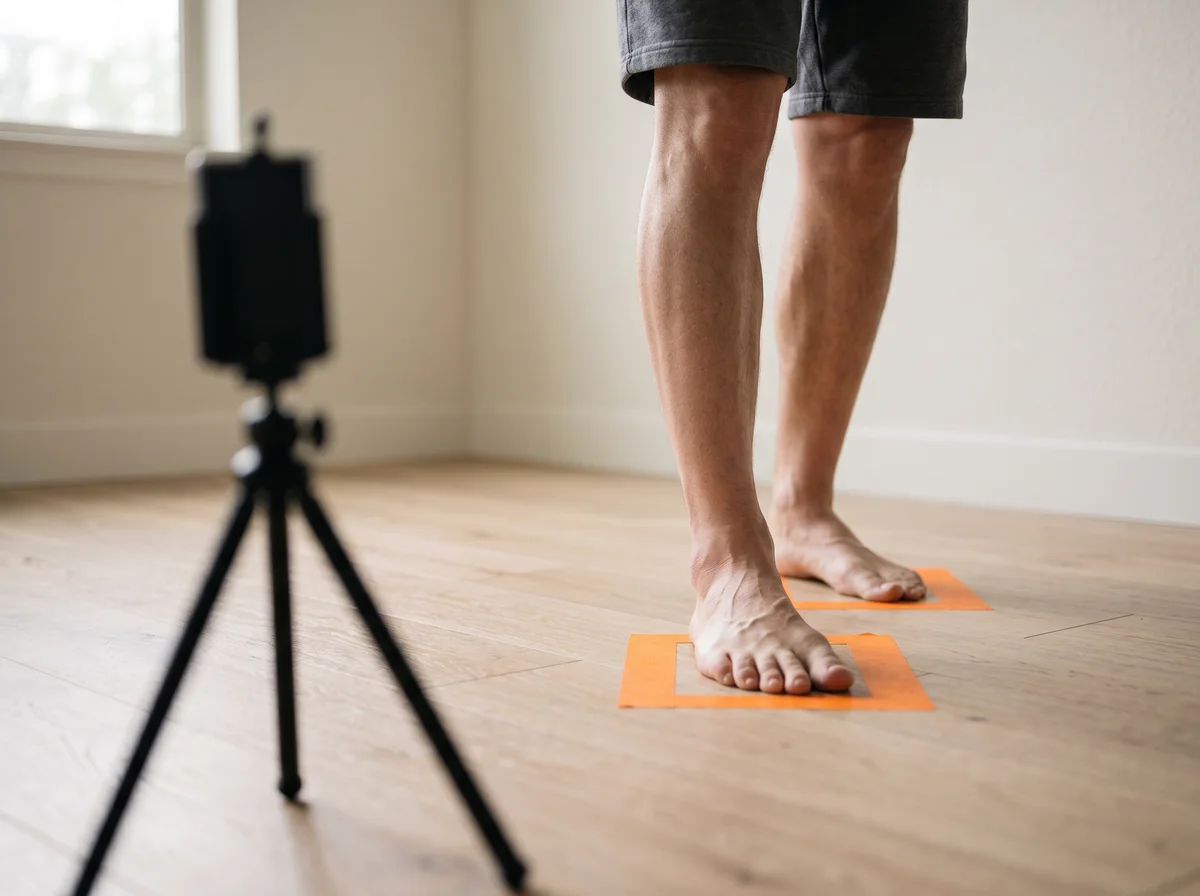
Choose a plain wall with room to step back. Put a small piece of tape on the floor where your feet go and another where the stand goes. If you travel during the challenge, pick the closest equivalent (a plain hotel wall) and expect those days to look a little different.
Same time, same light
Shoot in the morning, right after waking and using the bathroom: before food, a gallon of water and two workouts change how you look. It's also the easiest time to remember. Light matters as much as timing. Overhead light deepens shadows and makes muscle definition look sharper; window light changes with weather and season. Use the same lamps every time, and keep blinds the same.
Phone on a stand, timer on, never a mirror
A mirror selfie puts the phone in the shot, hides part of your body behind your arm, and changes angle every time. Prop the phone on a tripod or a shelf at about chest height, level, roughly 2 to 3 meters away, and use the timer. Your whole body should fit with a little space above your head and below your feet. Keep the 1x lens; wide-angle lenses distort proportions near the edges of the frame.
Same poses, in the same order
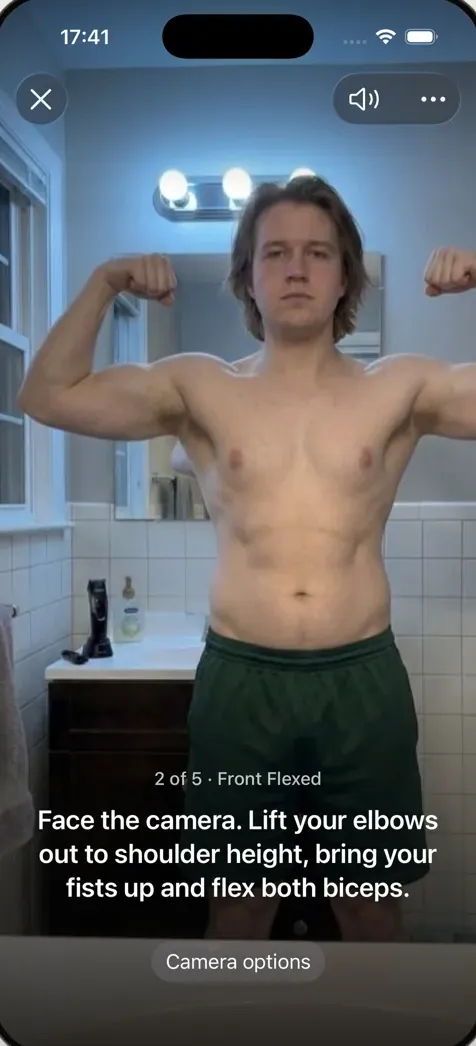
Front, side and back cover almost everything. If you want more detail, a five-pose routine adds flexed versions: front relaxed, front flexed, right side, back relaxed, back flexed. Our guide to progress picture poses walks through each one. Whatever you choose, keep your stance, arm position and breathing the same: relaxed means relaxed, not sucked in.
Same clothes
Wear the same fitted shorts, briefs or sports bra every time, or rotate through a couple of identical items. Waistbands and fabric change how a midsection reads in a photo.
Make it take a minute
The daily photo is the easiest of the five tasks to forget late at night, and forgetting it restarts the challenge. Attach it to something you already do every morning, keep the stand set up if you can, and run the same short routine every day:
- Right after waking, before water, food or a workout
- Same lamps on, blinds the same as day 1
- Same shorts or sports bra
- Phone on the stand at its tape mark, level, 1x lens, timer on
- Feet on your tape mark, facing the same way
- Breathe out normally; don't suck in or flex unless the pose calls for it
- Front, side and back (or all five poses), in the same order
- Check the shot is sharp and head-to-feet, then tick it off for the day
For general technique beyond 75 Hard, see the full guide on how to take progress photos.
How to make day 1, 25, 50 and 75 comparisons
Comparing day 40 to day 41 tells you nothing. Day-to-day differences in water, food, sleep and light are bigger than a day of real change, so daily comparisons mostly show noise. Checkpoints spaced a few weeks apart are where change has a chance to show up. Step through what to do at each one:
Day 1: your baseline
Take this one carefully: it is the reference every later photo is judged against. Shoot every pose you plan to repeat, and write down the lamp, the clothes and where the stand sits.
Day 25: the first honest look
Put day 25 next to day 1, same pose to same pose. Change may be small or invisible this early; that's normal. Use this checkpoint to fix your setup if framing or light has drifted.
Day 50: look at the side view
Two-thirds through, compare all three checkpoints in a row. Changes in the midsection and posture often read first from the side, before they're obvious from the front.
Day 75: your before-and-after
Same spot, same light, same clothes as day 1. No pump, no new lamp, no different pose for the final shot. The day 1 and day 75 pair is your fair before-and-after.
- Pick the checkpoints. Day 1, 25, 50 and 75 split the challenge into roughly even thirds. If one is blurry or off, use the nearest day.
- Compare the same pose to the same pose. Front to front, side to side. Never compare a flexed photo to a relaxed one.
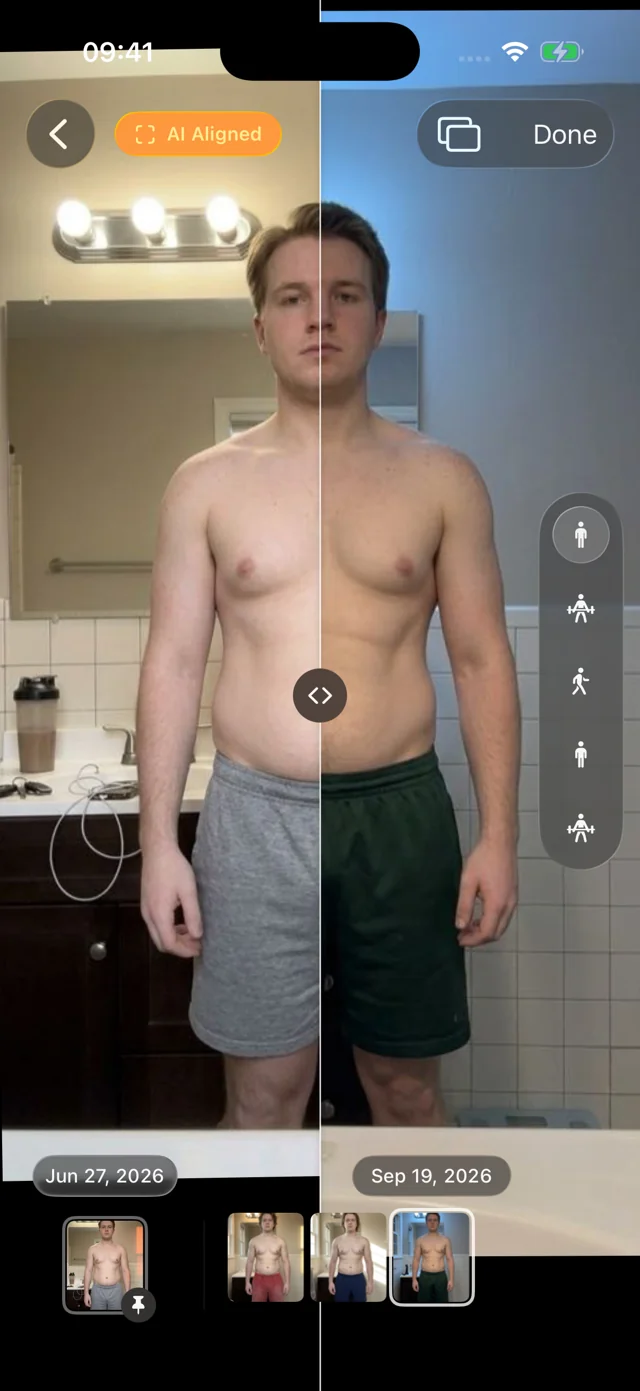
- Line the photos up. Even with a taped floor, framing drifts. Crop or scale each photo so your body sits at the same size and position in every image. Otherwise standing closer makes you look "bigger."
- Look side by side, then swap. A row shows the trend. Flipping between day 1 and day 75 at the same size makes small changes in shape easier to notice.
- Check the conditions. If day 50 looks great because it was taken under a different lamp, don't count it.
Here's why step 3 matters. Turn AI aligned off to see two photos exactly as shot, then on again to see them at the same scale and position:
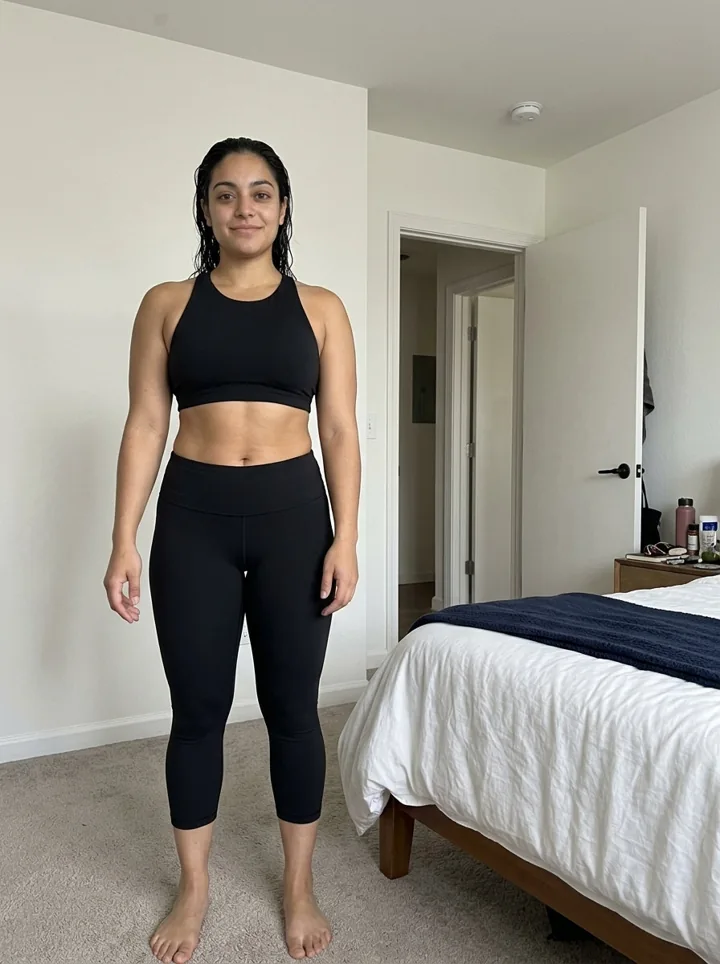
Alignment fixes framing, not rooms or light, which is why one fixed spot still matters. Our guide to before-and-after photos covers how to present the final pair without distorting it.
What to expect from 75 days of photos
Expect your photos to be less dramatic than the ones you see online. Viral 75 Hard results are a selected sample, and many are taken with flattering light, a pump, or a different pose on the last day.
- Day to day, you will see almost nothing. That's normal. It's why checkpoints exist.
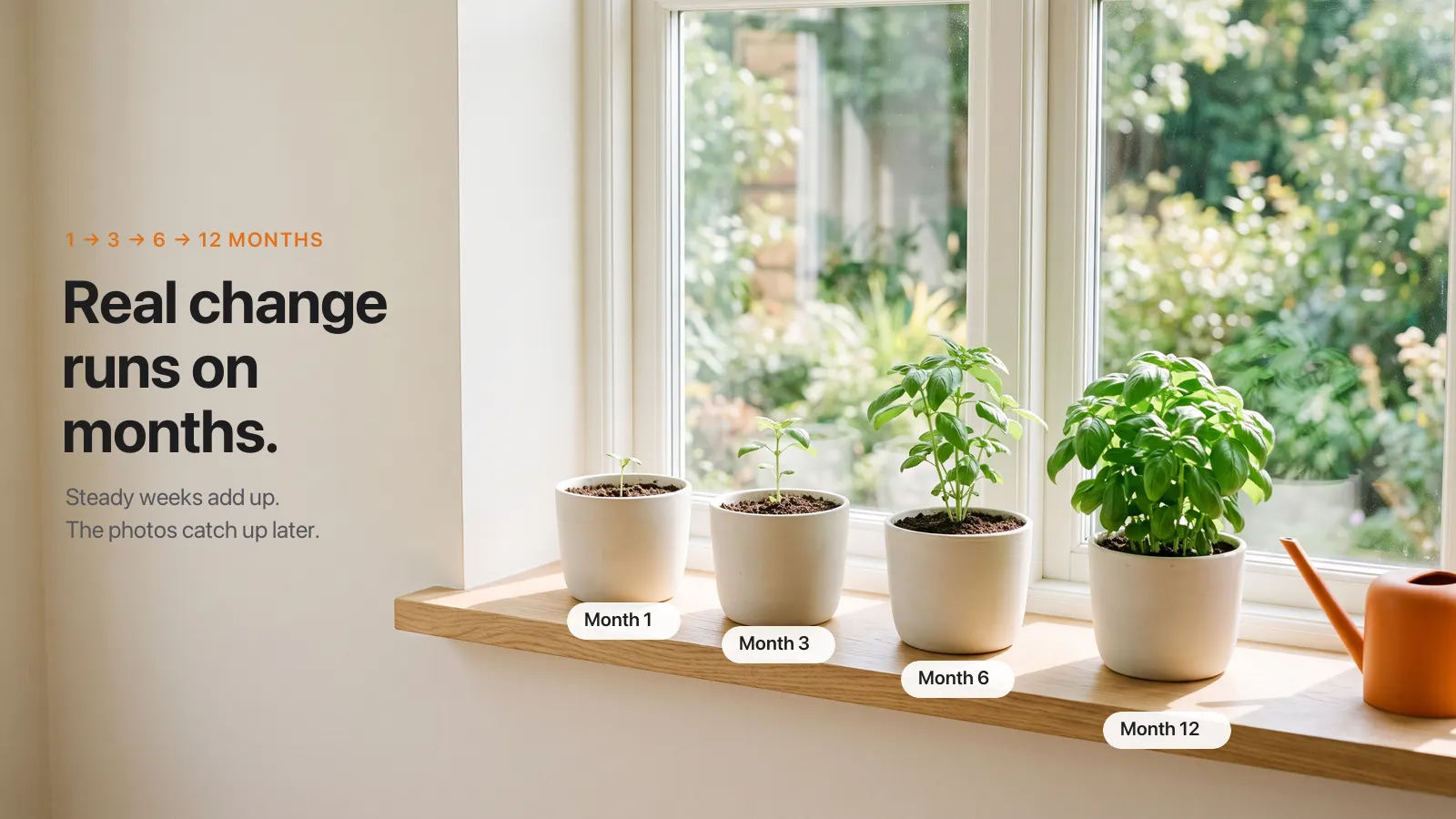
- Change varies a lot between people. Starting point, diet, training history, sleep, age and genetics all matter. Seventy-five days is about eleven weeks; for a sense of how change usually builds over three, six and twelve months, see the body transformation timeline.
- The scale and the photos can disagree. Water, sodium and training load move the scale daily. If you are losing fat while building some muscle, photos and the fit of your clothes may show more than the number does.
- Photos document; they don't grade. A photo can show that your shape changed. It can't tell you your health, your body fat percentage or whether you "did it right."
Is 75 Hard safe? A balanced note
75 Hard includes habits most people would call healthy: daily movement, reading, attention to food. But it was not designed as a medical or clinical program, and health professionals have raised specific concerns:
- No rest days. Two workouts a day for 75 days, with no planned recovery, raises the risk of overuse injuries, especially for beginners, according to a sports psychologist interviewed by Cleveland Clinic. Experts quoted by TODAY make the same point about recovery.
- Restriction and all-or-nothing rules. A strict diet with zero flexibility, plus restarting at day 1 after any slip, can feed an unhealthy cycle. Experts quoted by TODAY warn it may trigger relapse in people with a history of eating disorders, and Cleveland Clinic notes that daily progress photos can feed body-image struggles.
- A fixed gallon of water. Fluid needs vary by size, activity and health. Harvard Health notes that people with certain thyroid, kidney, liver or heart conditions, or on some medications, can take in too much water.
- Little research. Cleveland Clinic points out there is little to no scientific evidence about the program itself.
Using a 75 Hard app for your progress pictures
Searching for a "75 hard app" usually means one of two jobs: tracking the five daily tasks, or managing the photos.
The creator sells an official 75 HARD app that tracks the daily tasks, sends reminders and saves your progress photos inside the app. If you'd rather not install anything for the checklist, the free 75 Hard tracker on this site does the calendar and a printable sheet in your browser.
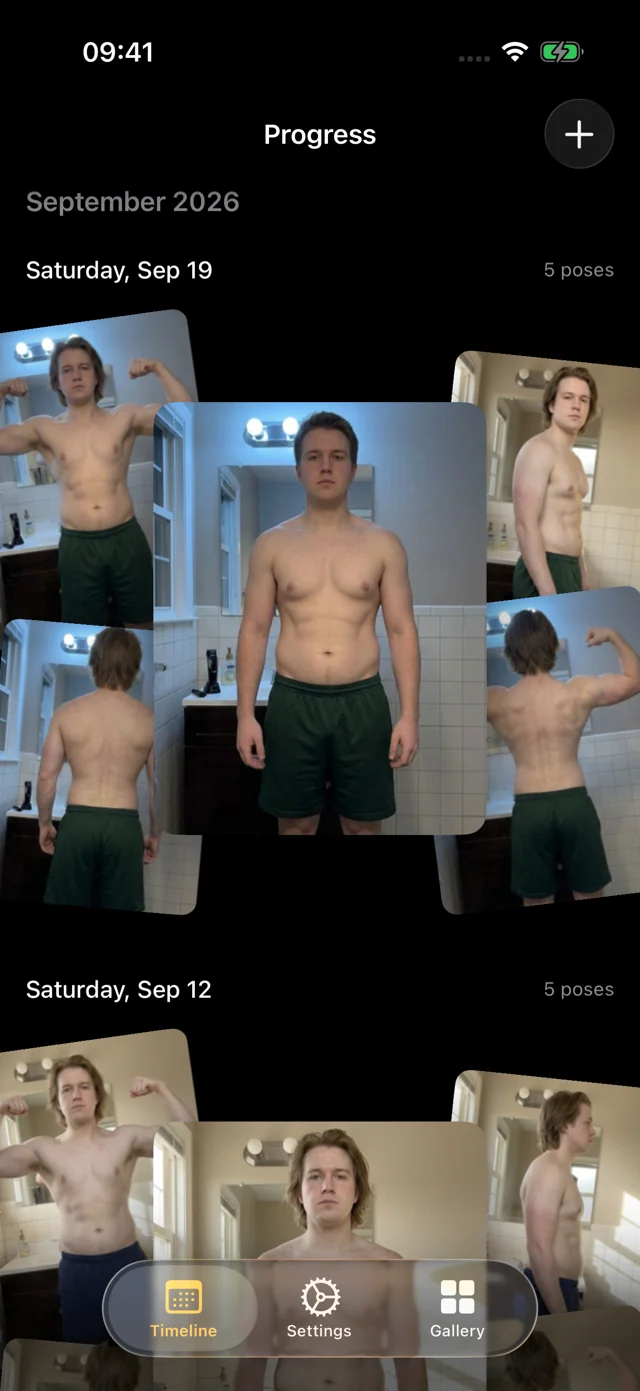
Progress does only the photo part, and doesn't track your diet, workouts, water or reading. It makes the photos comparable. You set your phone down, and on-device pose detection waits until you're fully in frame and holding still, counts you in, and a recorded voice calls each pose: front relaxed, front flexed, right side, back relaxed, back flexed. A full session takes about a minute without touching your phone. Every photo is AI aligned, so you can slide a divider across day 1 and day 75, or pin day 1 as your reference and scrub everything since. Photos stay on your device, with no account. If you've already started the challenge with your camera roll, you can import those photos and Progress will line them up too. An aligned timelapse video is in the works but isn’t available yet.
A practical combination: use whichever checklist you like for the five tasks, and a dedicated photo app for the one task where consistency is the whole point.
FAQ
What are the 5 rules of 75 Hard?
Follow a diet with no alcohol or cheat meals, do two 45-minute workouts (one outdoors), drink a gallon of water, read 10 pages of nonfiction, and take a progress picture, every day for 75 days. Miss one and you restart at day 1. See the official rules for the exact wording.
Do you have to take a progress picture every day on 75 Hard?
Yes. The daily progress picture is one of the five rules. The rules don't specify a pose or setup, so a consistent daily routine is up to you.
How long does it take to see results doing 75 Hard?
It varies widely, and most people see little change from one day to the next. Judge by aligned checkpoint photos from day 1, 25, 50 and 75, not daily photos or the scale alone.
Is 75 Hard bad for your body?
It isn't medically designed, and experts have raised concerns about the lack of rest days, strict restriction, a fixed water target and the all-or-nothing restart rule. Whether it's appropriate depends on your health. Ask a doctor or registered dietitian before starting.