Progress
3 Month Body Transformation: A Realistic Timeline
What a realistic 3 month body transformation looks like, plus 1, 6 and 12 months: evidence-based fat loss and muscle gain rates, and how to photograph it.

On this page 9 sections
- The body transformation timeline at a glance
- How fast bodies actually change
- 1 month gym transformation: what to expect
- 3 month body transformation: the first real milestone
- 6 month body transformation: change other people notice
- 1 year body transformation: where large change lives
- Why social media transformations mislead
- How to document each milestone so you can see it
- FAQ
A realistic 3 month body transformation is noticeable but not dramatic. If you are losing fat at a sustainable pace, expect roughly 10 to 20 pounds over 13 weeks, and if you are new to lifting, a few pounds of muscle at most. That is enough for clothes to fit differently and for consistent, aligned photos to show a clear difference. It won't look like the overnight change you see on social media.
The short version of the timeline: in month one, you mostly feel it (strength, energy, a noisy scale). By three months, measurements and photos start to agree. By six months, the change is obvious side by side. At a year, large change is possible, but it has come from steady weeks, not a single dramatic stretch.
Key takeaways
- Sustainable fat loss is about 0.5–1% of bodyweight a week: roughly 11–22 lb over 3 months at 180 lb.
- Muscle comes slower: study averages are around 3 lb across typical training programs, with beginners gaining fastest.
- Month 1 is strength and a noisy scale; month 3 is the first change you can photograph; month 6 is obvious side by side.
- Most "12 week" transformations online are staged with light, posture, pump and camera height.
- Lock your photo setup on day one and compare milestones against session 1, not last week.
The body transformation timeline at a glance
Step through the four milestones to see what typically changes at each.
You feel it before you see it
Typical fat loss: about 3–7 lb at 0.5–1% of bodyweight per week (for a 180 lb starting weight). Muscle: little visible change yet; early strength gains are mostly your nervous system learning the lifts.
Workouts feel easier and the bar gets heavier. The scale swings a few pounds with water and food. Photos: subtle, if anything. Your job this month is a careful baseline.
The first change you can photograph
Typical fat loss: about 11–22 lb over 13 weeks at 0.5–1% per week. Muscle: beginners may add a little in the shoulders, arms and legs.
Belts move a notch, the tape measure agrees, and session 1 next to week 13, framed the same way, shows a clear difference in waist, face and posture.
Change other people notice
Typical fat loss: about 20–40 lb is possible at a steady pace, though few people hold the top rate this long. Muscle: beginners keep getting stronger on most lifts, with visible shape in the back, shoulders and legs.
This is also where the first real plateau tends to arrive. Photos and measurements matter most here.
Where large change lives
Fat loss: slows as you get lighter; many people alternate dieting and maintenance across a year. Muscle: the fast beginner phase tapers; gains continue, more slowly.
Session 49 looks almost identical to session 50. Across twelve months, a consistent photo history shows a different body.
These are typical patterns, not promises. Your pace depends on your starting point, training, diet, sleep, age and health.
How fast bodies actually change
Two numbers drive every body transformation timeline: how fast you can lose fat without losing muscle, and how fast you can build muscle. Both are slower than most people expect.
Fat loss: about 0.5 to 1% of bodyweight per week
The CDC notes that people who lose weight gradually, about 1 to 2 pounds a week, are more likely to keep it off. Sports nutrition research frames the same idea as a percentage of bodyweight: an evidence review of natural bodybuilding preparation recommends losses of roughly 0.5 to 1% of bodyweight per week to maximize muscle retention.
Slower can also look better. In a study of elite athletes who strength-trained four times a week, the group losing about 0.7% of bodyweight per week gained lean mass while the group dieting roughly twice as fast did not. Both groups lost similar amounts of weight; the slower group simply kept more muscle doing it, which is what shows up in a photo.
Here is what that looks like on a bathroom scale. The chart below shows twelve weeks of illustrative daily weigh-ins for someone starting at 196 lb and losing a little under a pound a week, about 0.5% of bodyweight. Day to day, the scale bounces by as much as 3 or 4 pounds; the 7-day trend is what actually moves.
Illustrative data: twelve weeks of daily weigh-ins starting at 196 lb. Single days swing up and down by as much as 3–4 lb, while the 7-day average falls steadily by about 10 lb, a little under a pound a week.
Most people do not hold the top rate for six months straight, and nobody needs to. Plateaus, holidays and maintenance breaks are normal.
Muscle gain: fast for beginners, slow for everyone else
Muscle grows far more slowly than fat comes off. A meta-analysis of 111 resistance training studies in healthy adult men found an average increase of about 1.5 kg (roughly 3 pounds) of muscle mass across the training programs studied. That's a useful reality check against "I gained 15 pounds of muscle in 90 days."
Two things shape that number:
- Beginners gain fastest. If you have never lifted consistently, your first year is when change comes most quickly. People with years of training can work hard for a year and add only a little.
- Scale gains are not all muscle. Water, stored carbohydrate and some fat come along with a calorie surplus. A quick jump on the scale after starting a program is mostly not new muscle.
The American College of Sports Medicine's position stand suggests two to three resistance sessions per week for novices, with loads that increase as you get stronger, and notes that progress slows as training experience grows.
| Starting point | Month 1 strength | Muscle gain pace | Fat loss pace | What 3 months shows |
|---|---|---|---|---|
| New to lifting | Fast, mostly neural | Fastest it will ever be | 0.5–1% of weight a week | Clear change in aligned photos |
| Returning after a break | Fast, comes back quickly | Moderate | 0.5–1% of weight a week | Visible, often in shoulders and arms |
| Trained 3+ years | Slow and steady | Slow; small gains a year | Slower end keeps muscle | Subtle; compare monthly |
If you want to see how fat loss and muscle gain combine for your own numbers, try the body recomposition calculator. If you have trained for years and wonder how much room is left, the FFMI calculator puts your lean mass relative to height in context.
1 month gym transformation: what to expect
A 1 month gym transformation is mostly invisible in photos, and that is fine. The first month is where your body learns the work.
- You get stronger before you look different. Early strength gains come largely from your nervous system learning to recruit and coordinate muscle, not from muscle growth, a pattern described in classic research on neural adaptation to resistance training. Adding weight to the bar each week in month one is real progress, even if the mirror disagrees.
- The scale is noisy. Food volume, salt, carbohydrate and water can move the scale a few pounds in either direction from day to day. A new training program can add water to sore muscles at the same time fat is coming off.
- Photos show subtle changes, if any. Maybe a little less softness around the waist, or better posture. If your four-week photos look identical, you have not failed. You are early.
What to do in month one: take a careful baseline set of photos, a bodyweight trend (not a single weigh-in) and a waist measurement. Every later milestone gets compared with it. Our guide on how to take progress photos covers the setup.
3 month body transformation: the first real milestone
Three months is where most people can see their own body transformation for the first time, provided their photos are consistent. At a sustainable rate of fat loss, that can mean roughly 10 to 20 pounds lighter for many people. Beginners who lift consistently will be noticeably stronger and may have added a little muscle in the shoulders, arms and legs.
What you will usually notice by 12 weeks:
- Clothes fit differently. Belts move a notch, shirts sit differently across the shoulders, and jeans fit at the waist.
- Measurements move. Waist circumference often changes even during weeks when the scale stalls.
- Aligned photos show it. Session 1 next to week 12, framed the same way, typically shows a clear difference in waist, face and posture.
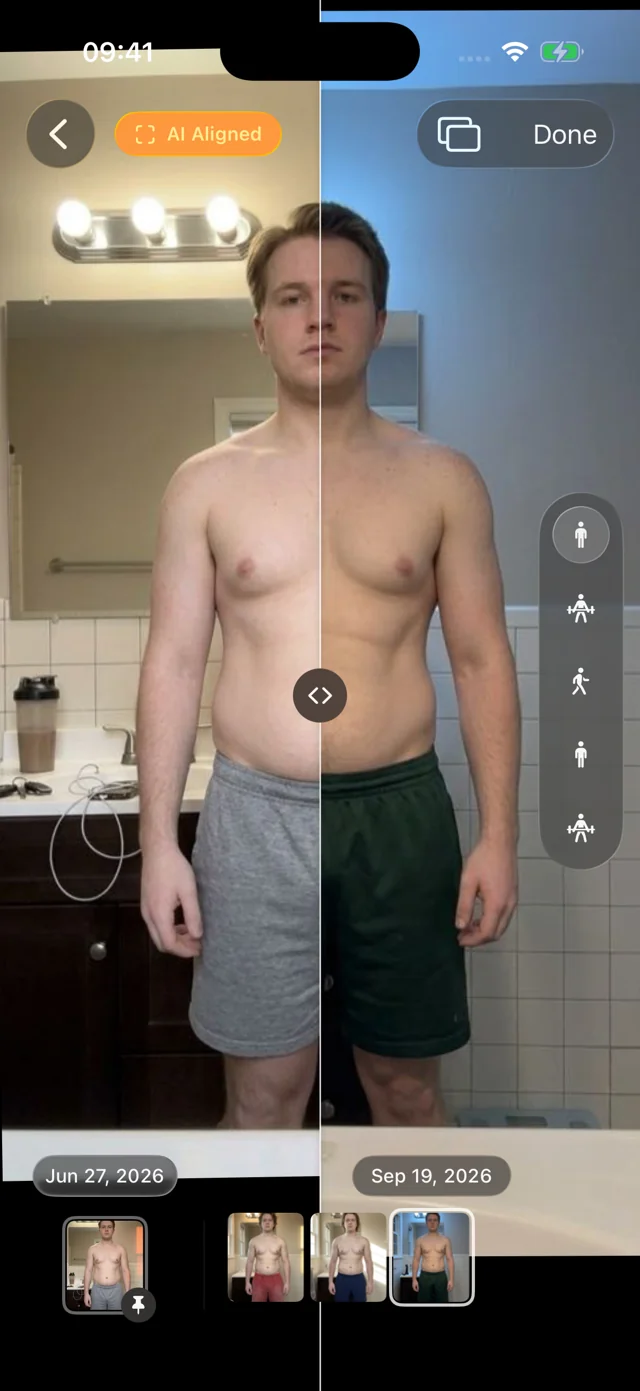
Scrub through sixteen weekly sessions below to get a feel for the pace. Week to week, almost nothing seems to happen; the change only reads when you jump from the start to the end.

Can you completely transform your body in 3 months?
Usually not "completely," and that word is where expectations go wrong. Three months is enough to change how you feel, perform and fit into clothes, and to see meaningful change in careful photos. It is rarely enough to go from untrained to the physique in a fitness ad. If you start with more weight to lose, change is often more visible early; if you are already lean, three months of hard work can look subtle and still be real.
If you are lifting and eating close to maintenance, your scale may barely move while your shape changes. That pattern, losing fat and gaining muscle at the same time, has its own guide: body recomposition before and after.
6 month body transformation: change other people notice
A 6 month body transformation is where change becomes hard to miss. If you have averaged even a moderate rate of fat loss, the difference between your first and latest photos is usually obvious without a divider or a magnifying glass. Beginners will typically have kept getting stronger on most lifts, with visible shape changes in the shoulders, back and legs.
This is also where most people hit their first real plateau. Weight loss slows as you get lighter, motivation dips, and life interrupts. Photos and measurements help here more than anywhere: when the scale has been flat for three weeks, an aligned comparison with month three can show that your shape is still changing. If you are stuck, read what to do about a weight loss plateau.
1 year body transformation: where large change lives
A 1 year body transformation is the honest version of the dramatic before and after. Twelve months of steady habits, with plateaus and imperfect weeks included, can add up to a substantial change in body fat, strength and shape. Many of the most convincing transformations you see online are actually one to several years long, presented as if they took a few months.
Two things change in year one:
- Muscle gain slows. The fast beginner phase tapers off. Strength still improves, but more gradually.
- Small differences stop being visible week to week. Your 50th session will look almost identical to your 49th. The change only shows when you compare across months, which is why a well-kept photo history becomes more valuable the longer you keep it.
Why social media transformations mislead
Real transformations exist, but the photos people post are often staged in ways that exaggerate change. The same person can look 10 pounds different within an hour by changing a few variables.
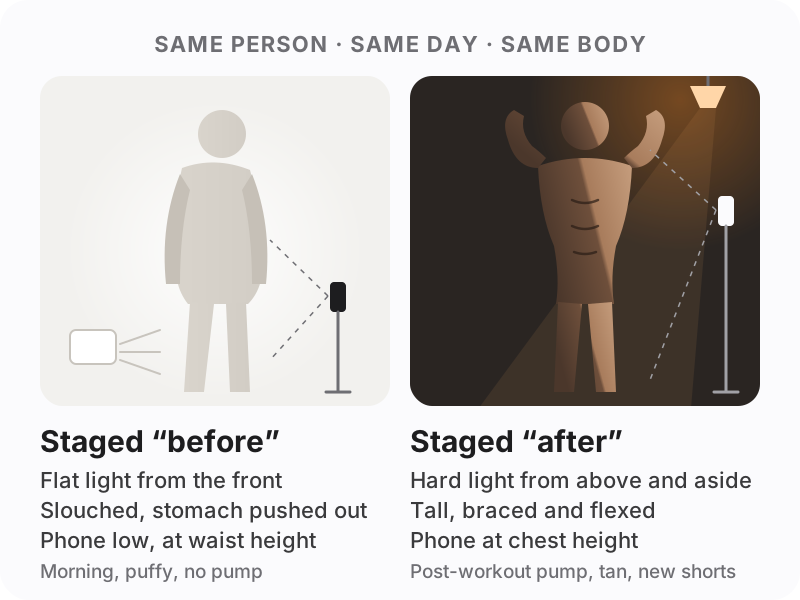
- Lighting. Flat, frontal light in the "before" hides muscle definition. Hard overhead or side light in the "after" carves out every line.
- Posture and flexing. Slouched, belly out and relaxed versus tall, braced and flexed. Pelvis tilt alone changes how the stomach looks.
- The pump. Photos taken right after training show temporarily fuller muscles.
- Dehydration and carbohydrate manipulation. Competitors sometimes cut water before a show; the bodybuilding review cited above warns this can be dangerous and may not improve appearance. It still shows up in "after" photos online.
- Camera distance and height. A phone held close distorts proportions. A camera at waist height versus chest height changes how long legs and torso look.
- Clothing and tan. Waistbands pulled up or down, darker skin tone from a tan, a different pair of shorts.
- Editing and selection. Filters, liquify tools, and simply choosing the worst "before" and the best "after" from dozens of shots.
- Time compression. A "12 week" caption on photos that are actually years apart, or a same-day before and after presented as a journey.
Your own comparisons work only when you keep those variables the same.
How to document each milestone so you can see it
The point of tracking a body transformation timeline is to see change that is too gradual to notice day to day. That takes a little discipline up front.
- Pick one spot and one light. Same room, same wall, ideally soft daylight from the front. Avoid overhead bathroom light.
- Same time, same conditions. Morning, after the bathroom and before eating or training. No pump, and no big salty dinner the night before if you can help it.
- Same clothes. Fitted shorts or underwear and the same top, with waistbands in the same place.
- Camera at a fixed height and distance. Use a tripod or prop the phone up at about chest height and use a timer. Never use a mirror selfie: the phone blocks your body and the angle changes every time.
- Same poses, every session. A standard set of front, side and back poses, relaxed and then flexed, makes every session comparable. See progress picture poses for how to hold each one.
- Take sessions every one to two weeks. You will not compare consecutive sessions much, but frequent sessions protect you from a bad-lighting day ruining a milestone.
- Mark the milestones. At 1, 3, 6 and 12 months, compare your latest session against your first, side by side, with your weight trend and waist measurement next to it.
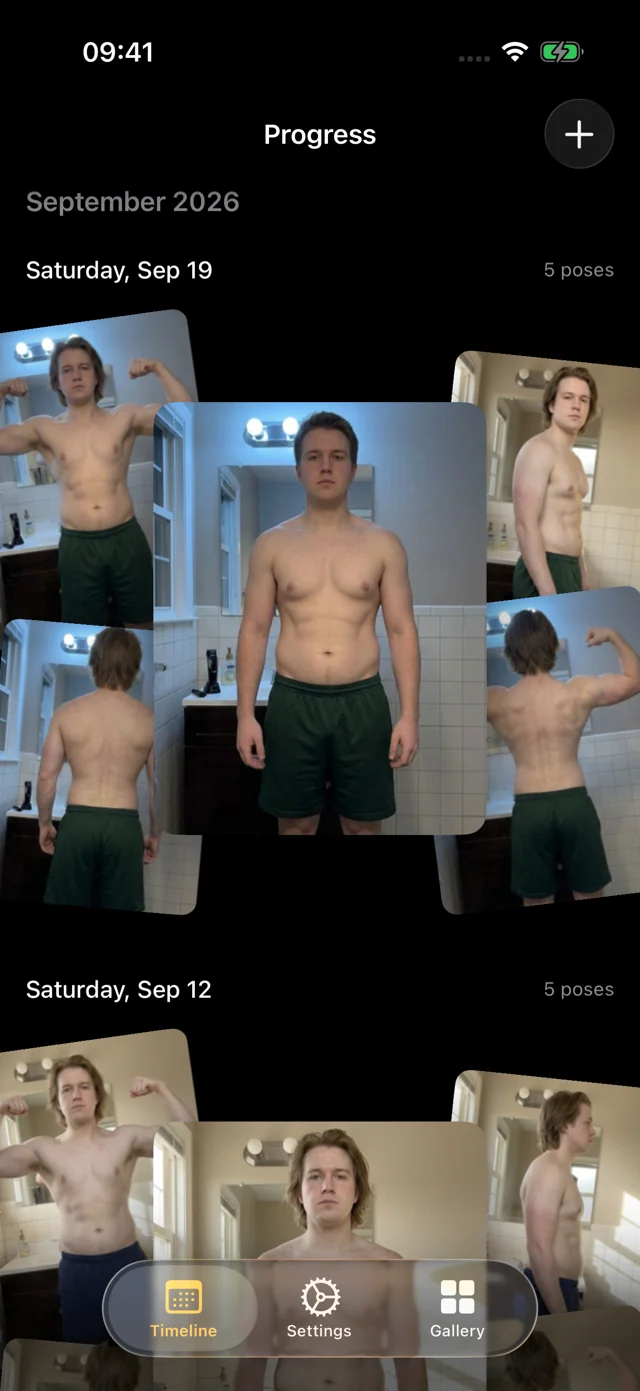
The hardest part is alignment. Even with a careful routine, you will stand a step closer one week and a few degrees off another. That small shift is enough to hide a month of change, or fake one. Progress handles this on your iPhone: every photo is AI aligned on-device, so you can slide a divider across session 1 and today, or pin your first session and scrub through everything since. It can also take the five poses for you hands-free, with a recorded voice calling each pose, in about a minute. Everything stays on your device.
If you already have old photos from the start of your journey, they still count. You can import them and compare against today; our guide to before and after photos covers making those comparisons fair.
FAQ
Is 20 lbs in 3 months realistic?
For some people, yes. Twenty pounds over 13 weeks is about 1.5 pounds per week, within the CDC's 1 to 2 pound range for gradual loss. It is more realistic for people who start heavier, since the same pounds are a smaller share of their bodyweight. For lighter people it would mean losing well over 1% of bodyweight per week, which makes holding on to muscle harder. Talk to your doctor before an aggressive diet.
Can you gain 10 lbs of muscle in 3 months?
It is unlikely for most people. Research averages are closer to about 3 pounds of added muscle mass across typical training programs, with beginners at the higher end. A 10-pound scale increase in three months will usually include water, stored carbohydrate and some fat.
How long does it take to see a body transformation?
Most people feel stronger within a few weeks, see changes in clothes and measurements by around two to three months, and see clear differences in consistent photos by three to six months. Comparing aligned photos from the same spot and light makes change visible sooner than the mirror.
How often should I take progress photos during a transformation?
Every one to two weeks works well. Compare milestones (month 1, 3, 6 and 12) against your first session rather than against last week, since week-to-week change is too small to see.