Progress
Weight Loss Plateau: Real Stall or Just Scale Noise?
Hit a weight loss plateau? Learn why the scale stalls, how to tell a real plateau from water-weight noise, what helps, and the non-scale victories to track.
On this page 9 sections
- What a weight loss plateau is (and what it isn't)
- Why weight loss plateaus happen
- How to tell a real plateau from noise
- Evidence-based ways to get past a plateau
- Scale not moving but clothes fitting better?
- Non-scale victories worth tracking
- How progress photos reveal what the scale hides
- The bottom line
- FAQ
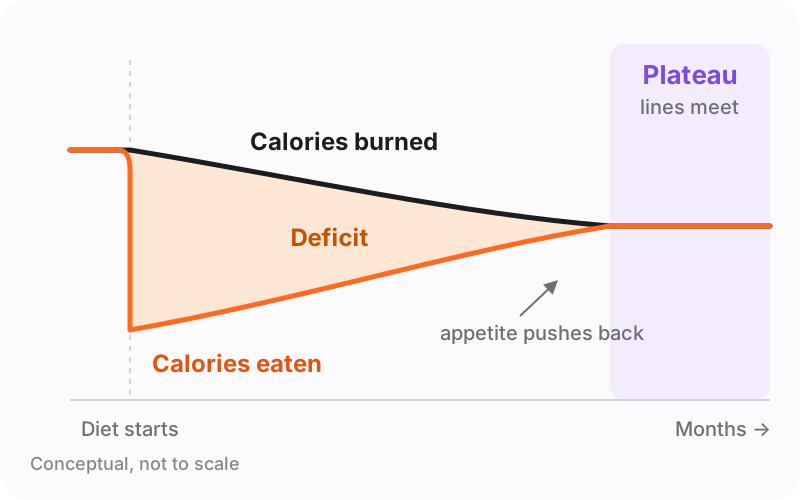
A weight loss plateau is a stretch of several weeks when your weight stops trending down even though you're still doing what worked before. It's normal. As you lose weight, your body burns a little less and, more importantly, your appetite pushes back harder, until the calories you eat match the calories you burn. But most "plateaus" people worry about are something else: a week or two of water-weight noise hiding a trend that's still moving.
So before you change anything, check three things: your weekly average weight (not today's number), a window of at least three to four weeks, and evidence the scale can't see, such as progress photos, a tape measure and how your clothes fit. If all of those are flat while you've been consistent, you have a real plateau, and there are sensible ways to respond. If they aren't, you're probably closer to a breakthrough than a stall.
Key takeaways
- Daily weight can swing several pounds from water alone. Judge the 7-day average, never one morning.
- Call it a plateau only after three to four weeks of a flat weekly average while you've been consistent.
- Real plateaus happen because your body needs less energy and your appetite rises, not because your metabolism is broken.
- Small, sustainable changes beat drastic cuts. There's no way to "shock" your body.
- Track a second signal: waist measurements and consistent progress photos often show change while the scale sits still.
What a weight loss plateau is (and what it isn't)
Your scale weight is the sum of fat, muscle, bone, organs, food in transit and a lot of water. Only one of those is what you're trying to change, and it changes slowly. The others swing daily.
The best-known source of noise is glycogen, the carbohydrate your muscles and liver store for fuel. Mayo Clinic notes that the quick drop many people see in the first weeks of a diet comes partly from glycogen, which is stored with water, and that this effect is temporary (Mayo Clinic). The reverse is true too: a carb-heavy meal, a salty dinner, a hard leg workout, poor sleep, travel or the menstrual cycle can add water and push the scale up for days without any change in body fat.
There's also a weekly rhythm. In a multi-country study of people in a weight-maintenance program, weight was highest on Monday and lowest on Friday, a weekly swing of about 0.35% of body weight (Turicchi et al., 2020). On a 180 lb body, that weekend effect alone is more than half a pound, which can be the entire weekly loss you're hoping to see.
Here's what that noise looks like in practice. The chart below shows six weeks of illustrative daily weigh-ins for someone losing a steady, healthy amount. Hover or drag across it, and turn the daily dots or the trend line off to see each on its own.
Illustrative data: six weeks of daily weigh-ins starting near 182 lb. On day 17 the scale reads 178.4 lb; on day 29 it reads 182.8 lb, up 4.4 lb in under two weeks. Over the same stretch the 7-day average keeps heading down, and across all six weeks it drops by about 4 lb.
Look at days 17 to 29. Judged morning by morning, that's twelve days of "gaining" 4 lb, exactly the kind of stretch that makes people abandon a plan. The orange 7-day trend kept heading down the whole time. That is why a stall of one or two weeks is rarely a plateau: it's usually fat loss continuing underneath a temporary layer of water.
Why weight loss plateaus happen
When the trend genuinely flattens, a few forces are usually at work. None of them means you've "broken" your metabolism. Together they close the gap between what you eat and what you burn.
Your body needs less energy
A smaller body costs less to run and less to move. Mayo Clinic points out that some of the weight you lose is muscle, which helps keep your metabolism up, so you burn fewer calories than you did at your starting weight (Mayo Clinic). A clinical review from the NIH's StatPearls adds that resting energy expenditure can fall more than you'd predict from the lost tissue alone, a response often called adaptive thermogenesis (StatPearls).
You move a little less without noticing
Non-exercise activity thermogenesis (NEAT) is the energy you burn through everything that isn't deliberate exercise: walking around, standing, fidgeting, chores. StatPearls lists a decline in NEAT among the causes of plateaus (StatPearls). When you're eating less, it's common to sit more, take fewer steps and feel less restless, all of which quietly shrink the deficit.
Appetite pushes back, and portions creep
This is the biggest factor and the least talked about. Researchers at the NIH estimated that for every kilogram (2.2 lb) of weight lost, appetite drives people to eat about 100 more calories a day above their earlier intake, an effect more than three times larger than the drop in calories burned (Polidori et al., 2016). In a later analysis, Kevin Hall at the NIH described how, with diet changes alone, weight loss typically plateaus within six to twelve months because rising appetite eventually matches the ongoing effort to cut calories (Hall, 2024).
In daily life, that looks like calorie creep: a slightly larger pour of olive oil, an extra handful of nuts, a weekend that drifts. No single choice matters much. Together they can close a deficit that was never very large to begin with.
How to tell a real plateau from noise
Use a simple rule: judge the trend, over weeks, with more than one signal. Step through the check below before you change your plan.
Average the week, don't read the morning
Weigh under the same conditions (same scale, same spot, first thing after the bathroom, before eating or drinking) and average each week's readings. Many scale apps call this trend weight. Compare one week's average to the next; a single morning tells you almost nothing.
Look at three to four weeks, not three to four days
If the weekly average has been flat for three or four weeks in a row, that's worth acting on. Shorter stalls are usually water. Rule out known disruptions first: a new training program, a vacation, a salty week, illness, a medication change or your menstrual cycle can each hide progress for a week or more.
Check what the scale can't see
Measure your waist and compare aligned progress photos taken two to four weeks apart. If your waist is smaller or the photos show change, you aren't on a plateau. Your scale is.
Flat on every signal? It's a real plateau.
If the weekly average, your waist and your photos have all held still for a month while you've been consistent, it's a true plateau. That's not a failure. It means your current routine now matches your current body, and it's time for one small, deliberate change.
A true plateau looks different from noise. The daily dots still bounce, but the trend line itself goes flat and stays there. Watch for the case below too: the scale levels off while the tape measure keeps moving, which usually means you're losing fat and holding or building muscle at the same time.
Illustrative data: eight weeks of daily weigh-ins. The 7-day trend falls from about 184 lb to about 181 lb over the first four weeks, then stays flat for the next four, while the waist measurement keeps shrinking. A flat scale is not the same as no progress.
Evidence-based ways to get past a plateau
There's no trick to "shock" your body. Mayo Clinic puts it plainly: to keep losing, you need to either increase activity or reduce the calories you eat, because the approach that got you here may now only maintain your weight (Mayo Clinic). Pick one or two of these, not all of them.
- Audit before you cut. Track what you eat honestly for one to two weeks, including oils, drinks, bites and weekends. Calorie creep is the most common reason the trend flattens, and simply noticing it often fixes it.
- Recover your everyday movement. Since NEAT tends to fall, add it back on purpose: more walking, stairs, standing breaks, a short walk after meals (StatPearls).
- Lift weights, or progress the program you have. Resistance training helps you hold on to muscle while you lose fat, which keeps your metabolism higher and changes how your body looks even when the scale barely moves (StatPearls).
- Prioritize protein and fiber. Both help with fullness, which matters because appetite is what pushes back hardest. A registered dietitian can help you set targets that suit you.
- Make a small, sustainable adjustment. A modest reduction or a little more activity is easier to keep than a dramatic cut that makes appetite even louder.
- Protect sleep and manage stress. Short sleep and stress tend to raise hunger and lower your energy for movement. They also affect water retention, which affects the scale.
- Consider maintaining on purpose. A plateau can be a good place to practice holding your new weight for a while. Maintenance is a skill, and the appetite research above suggests it takes ongoing effort, not just willpower in the first few months (Polidori et al., 2016).
Scale not moving but clothes fitting better?
That's common, and it usually means one of two things.
The first is water. A few pounds of temporary water can mask a pound or two of fat loss for days or weeks. Your jeans don't care about water the way the scale does.
The second is body recomposition: losing fat while holding or gaining muscle, especially if you've started strength training. Muscle is denser than fat, so the same weight takes up less space. Your waist shrinks, your arms and shoulders look more defined, and the number barely changes. If that's you, our guide to body recomposition before and after explains what to expect and how to track it.
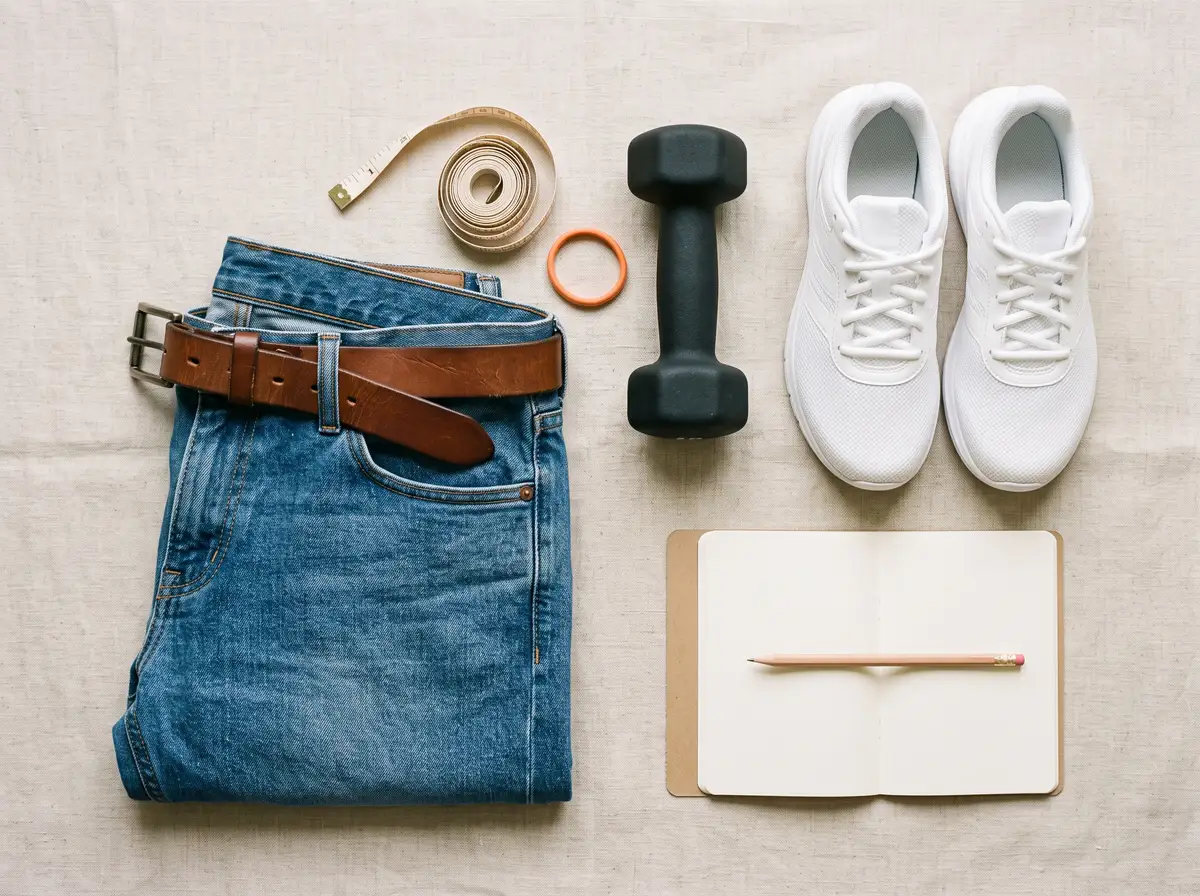
In both cases, better-fitting clothes are real data. Write them down.
Non-scale victories worth tracking
Non-scale victories (NSVs) are signs of progress a bathroom scale can't measure. They matter most during a plateau, because they keep you from abandoning a plan that's still working. Some are more reliable than others:
| Signal | Ignores water swings | Shows recomposition | Check every |
|---|---|---|---|
| Single weigh-in | Swings daily | Just one number | Not on its own |
| 7-day average | Mostly | Just one number | Weekly |
| Waist measurement | Bloating can shift it | Tracks fat at the waist | 2–4 weeks |
| Aligned progress photos | Mostly | Shows shape change | 2–4 weeks |
| Clothes fit | Mostly | Loosely | Anytime |
Here are the NSVs worth checking, roughly in order of how objective they are. Tap the ones you've noticed this month.
- Smaller waist, hip, chest or thigh measurement, taken at the same spots
- More weight, more reps or better form on your main lifts
- Walking or running farther, or the same pace feels easier
- Visible change in aligned progress photos
- Clothes looser, a belt notch tighter, or a size down
- Rings, watches or shoes fitting differently
- More energy through the afternoon
- Better sleep
- Less joint discomfort on the stairs
- Fewer cravings, or feeling more in control around food
Pick two or three you can check reliably. A short list you record every few weeks is more useful than a long one you remember vaguely. Clinical numbers your doctor tracks, such as blood pressure or blood sugar, count too.
If your waist is the measurement you track, compare it to your height with the waist-to-height ratio calculator. It turns one tape-measure reading into a number you can follow through a plateau, independent of what the scale says.
How progress photos reveal what the scale hides
Of all the non-scale victories, photos are the most convincing because they show shape, not just size. Fat loss and muscle gain change your waistline, the line of your shoulders, the space between your arms and torso, and how your posture looks from the side. A scale compresses all of that into one number.
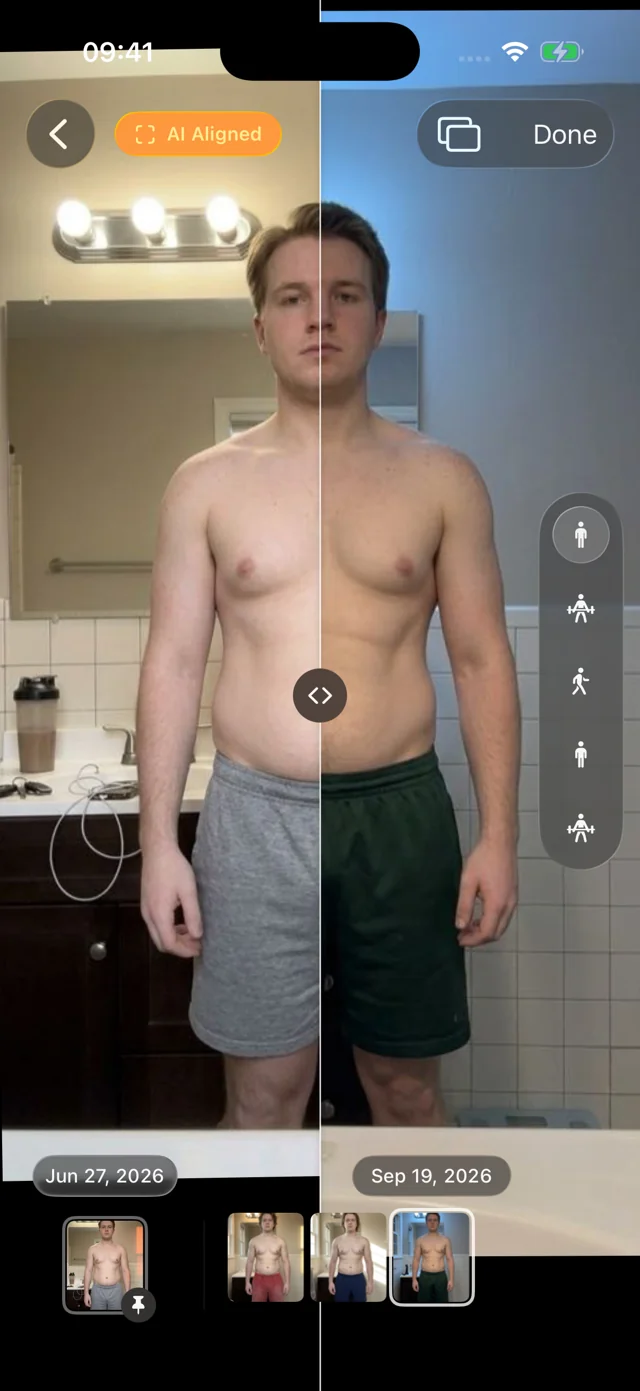
The catch is consistency. Weight loss progress pictures only work if the camera, distance, pose and framing match from session to session. A step closer, a slightly different angle or new lighting can make you look bigger or smaller than you are, and that noise is just as misleading as a water-heavy weigh-in. Drag the divider below, then turn AI aligned off to see the same photos exactly as they were shot.
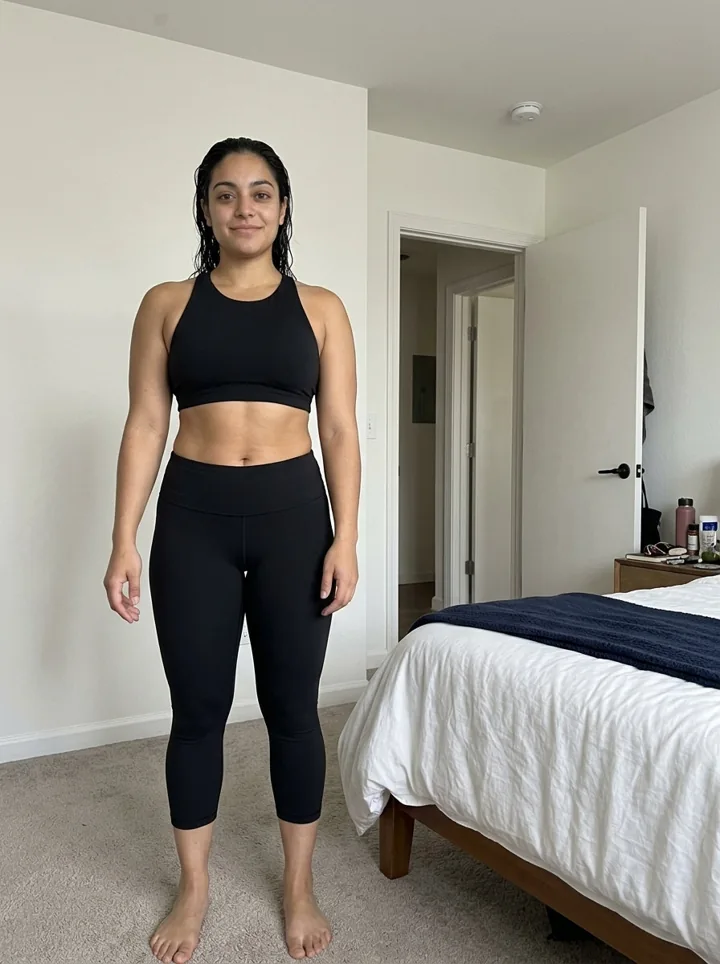
Our guide to taking progress photos covers the full setup, and the standard progress photo poses explains why front, side and back views each show something different. A few rules matter most during a plateau:
- Shoot every two to four weeks, not daily. Change is too gradual to see day to day.
- Same place, same light, same time of day, ideally in the morning, alongside your weigh-in.
- Same clothing, fitted enough to show your shape.
- Use a tripod or prop the phone up with a timer, never a mirror selfie, so the angle stays consistent.
- Compare against a fixed reference, like week one or the start of the stall, not just last week.
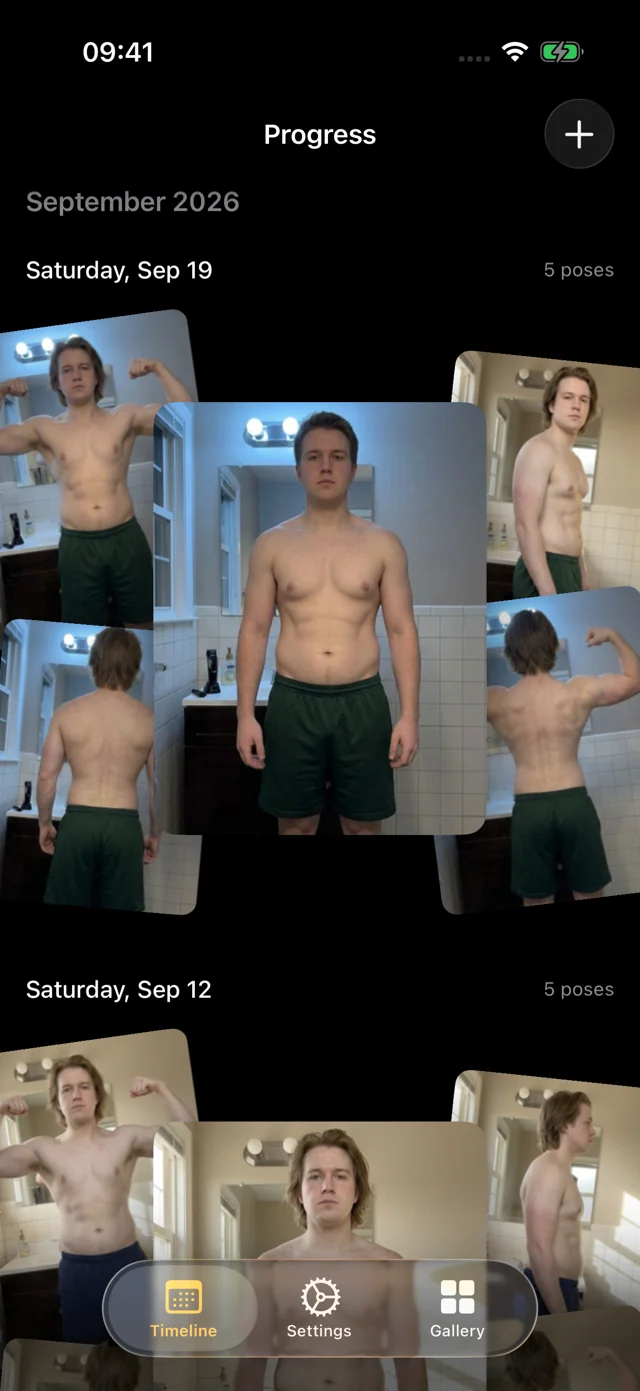
Progress is built for this. Every photo is AI aligned on your iPhone, so the only thing that changes between sessions is you. Slide a divider across two dates, or pin the day your plateau started and scrub through everything since. Hands-free capture walks you through five poses in about a minute, and your weight can sit alongside each session. Your photos stay on your device, with no account required.
The bottom line
Most weight loss plateaus are shorter and less mysterious than they feel. Judge your progress by the weekly trend over three to four weeks, not a single morning. If the trend has truly stalled, the cause is usually that your body needs a little less energy while your appetite asks for a little more. Small, sustainable changes in food and movement are the evidence-based response. And while you work through it, track what the scale can't see: your waist, your strength, your energy and a consistent set of progress photos.
FAQ
How long does a weight loss plateau last?
It depends on what's causing it. Water-weight stalls usually clear within one to three weeks. A true plateau, where your intake and expenditure have met, lasts until something changes, such as your eating, your activity or your goal. With diet changes alone, research from the NIH suggests weight loss commonly levels off somewhere within six to twelve months (Hall, 2024).
How do you shock your body out of a plateau?
You don't need to, and there's no reliable way to. Your body isn't stuck in a mode that a dramatic change will reset. What works is closing the gap that appeared between what you eat and what you burn: check for calorie creep, add everyday movement, keep strength training and make small adjustments you can sustain.
Will a cheat day break my plateau?
There's no good evidence that a cheat day restarts weight loss. A large, carb-heavy, salty meal usually raises your scale weight for a few days because of extra water and glycogen, which can make a plateau feel worse. If a planned higher-calorie day helps you stick with your plan, that's fine; just expect the temporary bump and judge it by your weekly average.
Can you lose inches but not weight?
Yes. If you're building or keeping muscle while losing fat, or if water retention is masking fat loss, your measurements and clothes can change while the scale doesn't. That's why tracking your waist and taking consistent progress photos is so useful during a plateau.