Progress
Water Weight Calculator: Water, Glycogen and Your Trend
Free water weight calculator: estimate how much of a scale change is water and glycogen, then paste daily weigh-ins to see your true trend and real rate.
This water weight calculator answers the question behind most scale panic: how much of that change is water? Estimate the water and glycogen shift from carbs, salt, your cycle, creatine and the weekend, then paste your daily weigh-ins to separate the real trend from the noise.
The calculator needs JavaScript. Here is the math it runs, so you can do it by hand:
- Glycogen: your body can store about 15 g of glycogen per kg of body weight, and each gram is stored with 3–4 g of water. Dropping from a normal-carb diet to keto typically releases 1.3–2.1 kg (3–4.7 lb) for a 180 lb person in the first few days.
- Salt: retained sodium pulls in fluid at roughly 1 liter (1 kg) per 3,200 mg. A salty day adds a few hundred grams to about 1 kg for a day or three.
- Cycle: weight around your period averages about 0.5 kg (1 lb) higher than early in the cycle, mostly extracellular water.
- Trend: a simple version is trend = yesterday’s trend + 10% × (today’s weight − yesterday’s trend), or the average of the last seven weigh-ins. Your true rate is the slope of a straight line through the last 2–4 weeks of weigh-ins, and your normal water swing is about twice the typical gap between a reading and the trend.
- Body water (Watson): men 2.447 − 0.09516 × age + 0.1074 × height cm + 0.3362 × weight kg; women −2.097 + 0.1069 × height cm + 0.2466 × weight kg, in liters.
- Water by volume: 1 liter weighs 1 kg (2.2 lb); a US gallon weighs about 8.34 lb.
How the water weight calculator works
Your scale reports everything at once: fat, muscle, bone, organs, food in transit and roughly 45–60% water. Fat changes slowly. Water can move several pounds overnight. The Water weight tab adds up the biggest causes of a water shift and shows each as a range.

| Factor | What the calculator assumes | Typical size | Source |
|---|---|---|---|
| Carbs (glycogen) | Capacity ≈ 12–15 g glycogen per kg body weight; stores fill with habitual carb intake; 3–4 g water per g glycogen | 1–5 lb | Acheson 1988, Kreitzman 1992 |
| Salt | Extra sodium, 25–60% retained short term, with isotonic fluid (≈3,220 mg per liter) | 0.5–1.5 lb | Heer 2009 |
| Menstrual cycle | Peaks on the first days of the period; average +0.45 kg | 0–2 lb | Kanellakis 2023, White 2011 |
| Creatine | Loading retains about 0.5–1.0 L of fluid | 1–2 lb | ISSN position stand |
| Weekend | Monday weights run ≈0.35% higher than Friday on average | 0.3–1 lb | Turicchi 2020 |
Glycogen is the biggest factor. The model treats your stores as a fraction of capacity that rises with how many grams of carbohydrate you eat per kilogram of body weight: about 45% full on a typical 3–4 g/kg diet (around 500 g for a 70 kg adult) and nearly empty on keto. The water released or stored is:
Water shift = capacity × body weight × (fill now − fill before) × (1 + water per gram)
Capacity runs 12–15 g/kg and water 3–4 g per gram, so the result is a range. The upper end fits muscular, active people. If you carry more body fat, expect the lower end, since glycogen lives mainly in muscle and liver. Sodium, cycle, creatine and weekend shifts add on top.
Enter your scale change and the calculator splits it: the part water and glycogen can explain, and what’s left over, which is more likely real tissue.
How much water weight can you lose?
Most people can lose about 2–5 lb (1–2 kg) of water weight, and almost all of it comes from glycogen. Cutting carbs hard empties your glycogen stores over two to four days, and the water stored with them leaves too. That is the famous first-week drop on low-carb diets, and it is real weight, but it isn’t fat. It returns within a few days of eating carbs again, which is also why a single big carb day can add two or three pounds overnight.
Salt and hormones add another pound or two in either direction, and they reverse on their own. Beyond that, there is no meaningful “water weight” left to lose for a healthy, normally hydrated adult. Sweating or skipping fluids to push the number down only dehydrates you, and the water comes back with your next drink.
Key takeaways
- Carbs drive the biggest water swings: each gram of stored glycogen holds 3–4 g of water.
- A salty day, your cycle, creatine or a weekend can each add about 0.5–2 lb that isn’t fat.
- Judge progress by a smoothed trend over 2–4 weeks, never by one morning’s number.
- Call it a plateau only when the trend is flat for three or more weeks and your waist and photos agree.
Weight fluctuation: how much is normal?
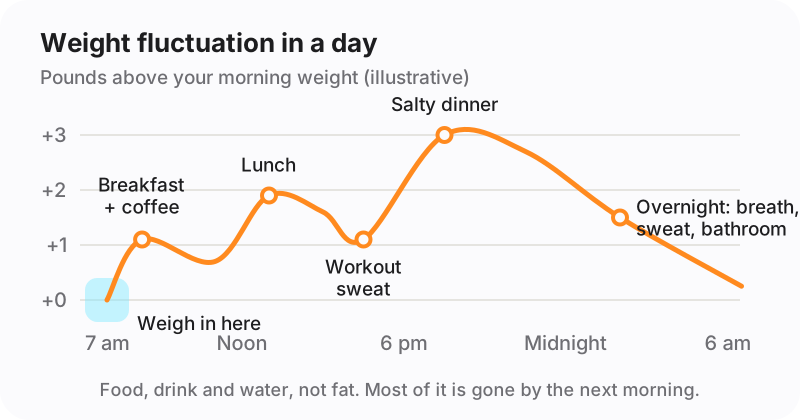
Weight fluctuation is normal, and usually bigger than people expect. For adults at a healthy weight, a typical day swings 2 to 3 pounds either way, a window of about 5 to 6 pounds (Cleveland Clinic). None of that is fat: gaining a pound of fat takes a surplus of thousands of calories, not one dinner.
Weight fluctuation in a day
Your weight fluctuation in a day follows a predictable shape. You're lightest on waking, after a night of breathing and sweating out water with nothing coming in. Every meal and drink then adds its full weight until it's digested and excreted, so most people weigh a few pounds more by evening, and a salty or carb-heavy dinner pushes it higher. That's why the time of your weigh-in matters more than almost anything else.
Daily weight fluctuation from one morning to the next
Even weighed at the same time every morning, a reading can sit a pound or two above or below yesterday's. The pattern is weekly too: in a European study of more than 1,000 adults weighing themselves on connected scales, weight rose over the weekend and came back down through the week, a swing of about 0.35% (Turicchi 2020). For a 180 lb person, that's more than half a pound of weekend that fades by midweek.
What causes weight fluctuation
- Carbohydrates. Each gram of stored glycogen holds 3–4 g of water, so a high-carb day can add a pound or more overnight.
- Salt. Extra sodium holds extra water until your kidneys clear it, usually within one to three days.
- Food and drink in transit. A liter of water weighs a kilogram the moment you drink it; a big meal weighs what it weighs until it's digested.
- Bowel movements. Constipation or a missed morning routine can add a pound or two.
- Hormones. Many women weigh more in the days around their period, mostly from extracellular water.
- Training. A hard or new workout makes muscles hold fluid for repair for a few days. A long sweaty session can briefly push weight down until you rehydrate.
- Sleep, stress, travel, alcohol and some medications all shift fluid balance too.
The calculator's Water weight tab puts a size on the biggest of these, so you can see whether a jump is within what they explain.
How to read fluctuation with the trend analyzer
Paste a few weeks of morning weigh-ins into the Trend vs noise tab below, and it measures your own fluctuation instead of a generic rule. The shaded water swing band is two standard deviations of your day-to-day scatter around the trend, so about 95% of normal days fall inside it. A morning outside the band gets a ringed dot: look back a day for a salty meal, a big carb day or a hard workout. If the next few readings fall back inside, it was water. If the trend line itself bends, that's real change.
Trend vs noise: your moving average weight
The Trend vs noise tab is a moving average weight tracker with error bars. Paste a log from any app or spreadsheet (dates and weights, one per line), add today’s weigh-in, or load a sample. It draws four things:
- Weigh-ins as dots. Ringed dots fall outside your normal range: likely a salty meal, a hard workout or your cycle.
- The trend line. By default it’s a lag-free smoothed trend: a local straight-line fit through the surrounding two to three weeks, so it doesn’t trail behind a falling weight. You can switch to the classic exponentially smoothed average from The Hacker’s Diet, where the trend moves 10% of the way toward each new reading, or a plain trailing 7-day average. Both are fine for daily use, but both run a few days behind: while you’re losing a pound a week, a 10% average sits about 1.3 lb above where you really are. Missed days are fine with any of them.
- The water swing band, two standard deviations of your own day-to-day scatter around the smoothed trend. About 95% of your normal days land inside it.
- The rate estimate, a dashed line fitted through the last 2, 4 or 8 weeks. Its slope is your true weight loss trend per week, shown with a ± range. The range is wider than raw scatter suggests, because water swings come in runs (a salty weekend lasts more than one day).
People who lose about 1 to 2 pounds a week are more likely to keep it off (CDC). The calculator also shows your rate as a percentage of body weight, which compares fairly across sizes.
How to read the verdict
- Still losing: the whole ± range is below zero. A bad week on the scale doesn’t change that.
- Probably still losing: heading down, but only just clear of the noise. Give it another week or two.
- Too noisy to tell yet: your swings are big compared with your rate. The calculator estimates how many more days of weigh-ins will settle it.
- Flat so far, but too early: less than three weeks of data. Keep going.
- Plateau looks real: the trend has been flat within a narrow margin for three or more weeks. Read how to break a weight loss plateau before you cut anything.
- Trending up: the rise is bigger than noise explains.
Your log stays in your browser. Turn on Remember my log on this device to keep it between visits; it’s saved in this browser and won’t appear on your other devices. Copy share link puts the numbers in the link itself (up to 180 days), so whoever you send it to sees exactly your chart.
How to weigh yourself for a cleaner trend
Daily weigh-ins beat weekly ones because more readings average the noise down faster. Make each one as comparable as possible:
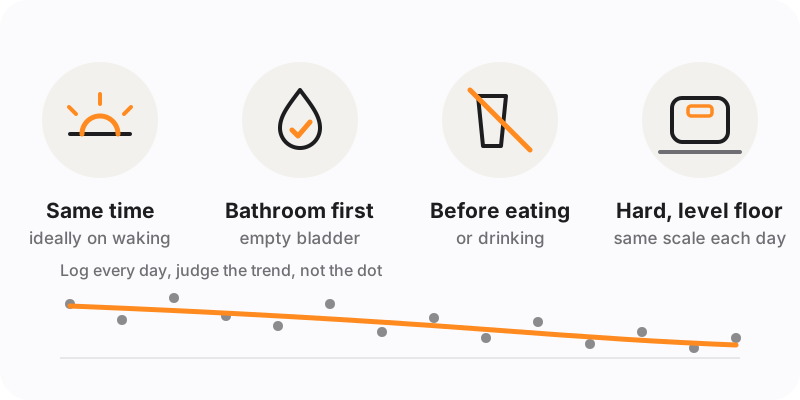
- Same time, ideally on waking. Weight rises through the day with food and drink.
- After the bathroom, before eating or drinking. A liter of water weighs a kilogram on the scale as soon as you drink it.
- Same scale, on a hard, level floor. Carpet and moving the scale both shift readings.
- Log every day, even the “bad” ones. Skipping high mornings biases the trend down and hides real stalls.
When the scale stalls, check what it can’t see
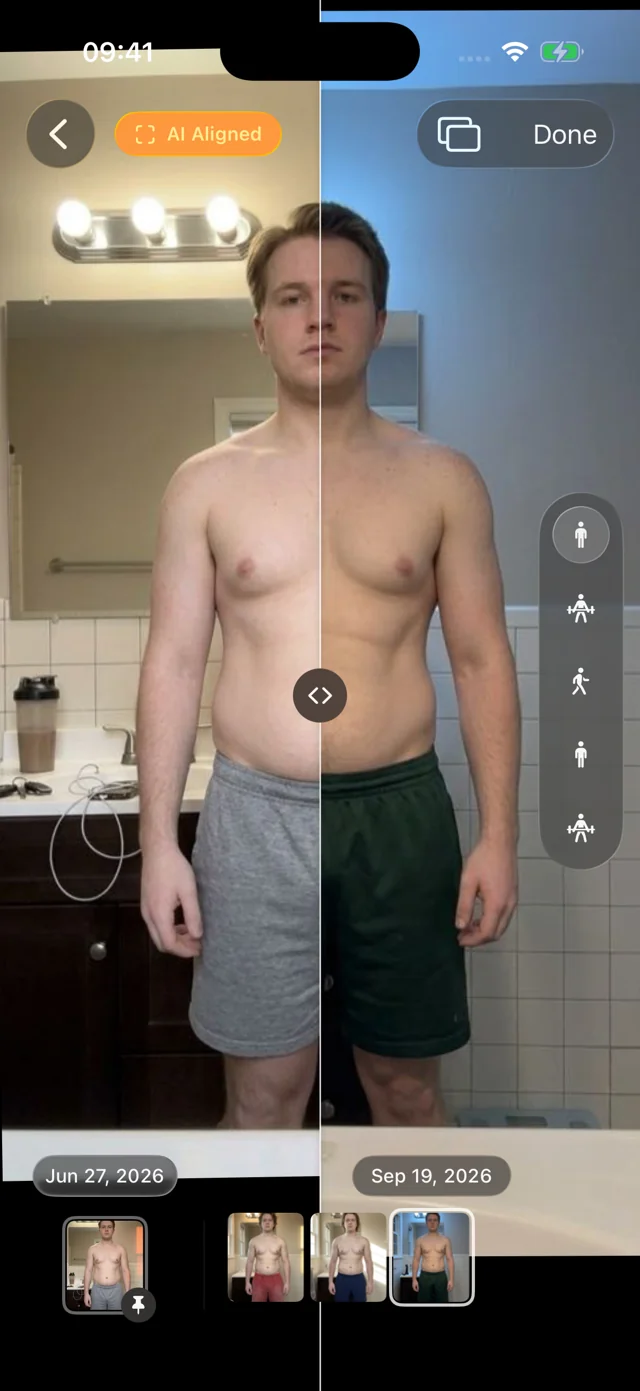
A flat trend on the scale doesn’t always mean nothing changed. If you’re lifting, you can lose fat and gain a little muscle while the scale stays put, which is the whole idea behind body recomposition. A tape measure at the navel and consistent progress photos catch that change when the scale can’t. The guide to taking progress photos covers the setup: same spot, same light, same poses.
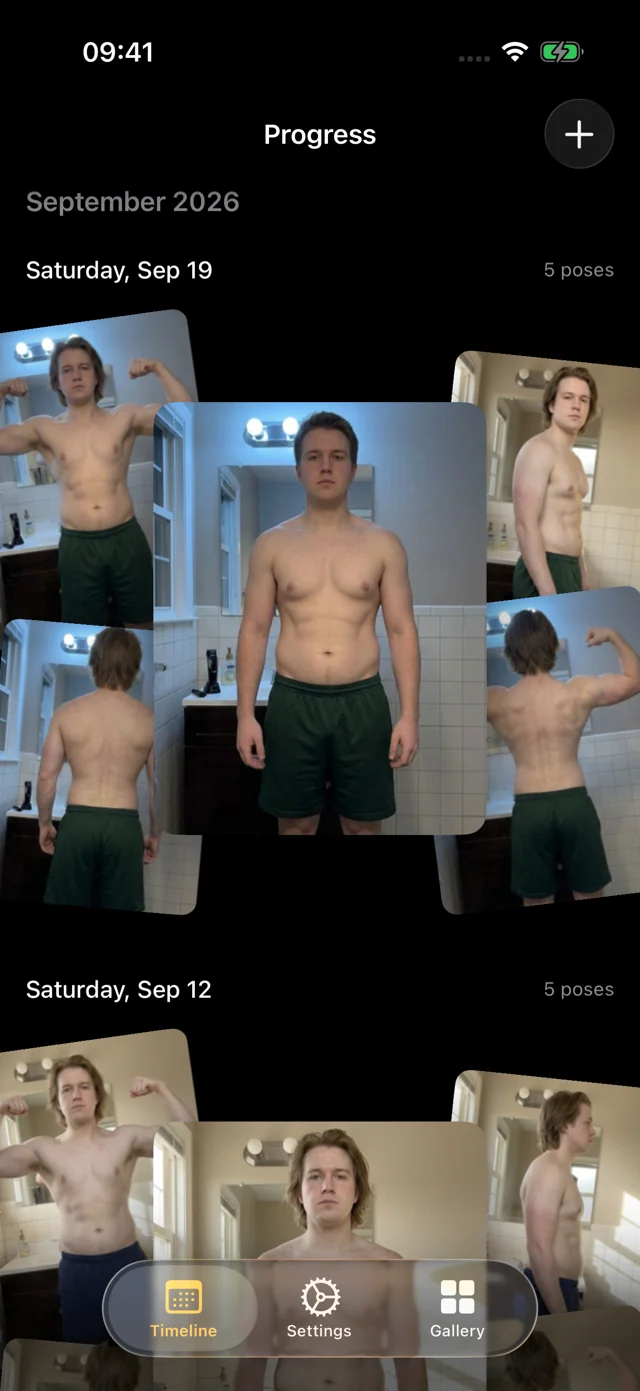
That’s what we built Progress for. It lines up every photo with on-device AI, so this month and last month compare fairly, and it keeps your weight right alongside your photos.
Accuracy and limits
- The ranges are population estimates. Glycogen capacity, sodium handling and hormonal water vary a lot between people. The calculator shows plausible ranges, not a measurement of you.
- Glycogen changes take days. “Carbs now” means what you’ve eaten over the past several days, not one meal.
- Other things move water too: a hard new workout (muscle repair holds fluid for a few days), poor sleep, travel, alcohol, constipation and some medications.
- The trend needs data. With fewer than two weeks of weigh-ins, every rate is uncertain. The ± range tells you how much.
- Body water is an estimate. The Watson equations come from 723 adults (Watson 1980) and can be off by several liters for very lean or very muscular people.
FAQ
How do I calculate my water weight?
Estimate your total body water with the Watson formula (the Body water tab): it’s usually about 45–60% of body weight, lower with more body fat. To estimate how much of a recent change is water, add up the shifts from glycogen (3–4 g of water per gram of stored carbohydrate), salt, your cycle and creatine. Or log daily weights and look at how far each reading sits from your smoothed trend: that gap is mostly water.
How much does a gallon of water weigh?
A US gallon of fresh water weighs about 8.34 lb (3.78 kg) at its densest, 39°F, and about 8.33 lb at room temperature. A liter weighs 1 kg (2.2 lb), and a pint weighs about 1.04 lb, hence “a pint’s a pound.”
Does 4 oz of water weigh 4 oz?
Nearly. Four US fluid ounces of water weigh about 4.17 ounces (118 g). Fluid ounces measure volume and ounces measure weight; for water they differ by about 4%.
How fast do you lose water weight?
Glycogen-related water mostly leaves within two to four days of cutting carbs. Salt-related water usually clears in one to three days once your intake returns to normal, and cycle-related water fades a few days into your period. After that, a steady downward trend reflects real fat loss.
How much weight fluctuation is normal in a day?
For most adults, 2 to 3 pounds either way, a window of about 5 to 6 pounds over a day, according to Cleveland Clinic. You're lightest on waking and heaviest in the evening after meals and drinks. Weigh in first thing in the morning and judge the trend over weeks, not one reading.
Why does my weight fluctuate so much from day to day?
Mostly water and the contents of your gut. Carbs, salt, alcohol, hard workouts, your menstrual cycle, sleep and bowel movements all change how much water you hold or carry. A gain of 2 to 4 pounds overnight is almost never fat. If swings come with swelling, shortness of breath or don't settle within a few days, talk to a clinician.
How much water should I drink for my weight?
There’s no precise weight-based rule. The National Academies set adequate total water intake (from all drinks and food) at about 3.7 L a day for men and 2.7 L for women (National Academies), and more in heat or with exercise. Drinking more water doesn’t cause water retention; if anything, steady hydration makes your daily weigh-ins less noisy.