Progress
Body Fat Percentage Calculator (US Navy Tape Method)
Free body fat percentage calculator using the US Navy tape method. See your estimate, ACE category, fat and lean mass, and how to measure neck, waist and hips.
This body fat percentage calculator uses the US Navy circumference method: a tape measure, your height and two or three measurements. Results update as you type.
The calculator needs JavaScript. You can work it out by hand with the US Navy formula, using centimeters and base-10 logarithms:
- Men: body fat % = 495 ÷ (1.0324 − 0.19077 × log(waist − neck) + 0.15456 × log(height)) − 450
- Women: body fat % = 495 ÷ (1.29579 − 0.35004 × log(waist + hips − neck) + 0.22100 × log(height)) − 450
Measure men’s waist at the navel; women’s at the narrowest point, plus hips at the widest point. Then compare your result with the ACE categories below.
How the US Navy body fat formula works
The circumference method comes from Naval Health Research Center studies by J. A. Hodgdon and M. B. Beckett in 1984. They compared Navy personnel's tape measurements with underwater weighing, the reference method of the time, and kept the sites that best predicted the result. The neck stands in for lean, muscular build; the waist (and, for women, the hips) captures where most body fat is stored; height scales everything to your frame.
The equations predict body density, which the calculator converts to body fat with Siri's standard formula (495 ÷ density − 450). With every measurement in centimeters:
| Formula | |
|---|---|
| Men | 495 ÷ (1.0324 − 0.19077 × log₁₀(waist − neck) + 0.15456 × log₁₀(height)) − 450 |
| Women | 495 ÷ (1.29579 − 0.35004 × log₁₀(waist + hips − neck) + 0.22100 × log₁₀(height)) − 450 |
The US military's inch-based versions (for men, 86.010 × log₁₀(waist − neck) − 70.041 × log₁₀(height) + 36.76) approximate the same equations; the two land within a few tenths of a point of each other. The original report is Hodgdon & Beckett, Prediction of percent body fat for U.S. Navy men from body circumferences and height, NHRC Report 84-11.
If you add your weight, the calculator splits it into fat mass (weight × body fat %) and lean mass (everything else: muscle, bone, organs and water). Add your age too and it shows a second, BMI-based estimate from Deurenberg and colleagues: body fat % = 1.20 × BMI + 0.23 × age − 10.8 × sex − 5.4, where sex is 1 for men and 0 for women (Deurenberg et al., British Journal of Nutrition, 1991). Treat it as a rough cross-check: BMI only knows your height and weight, so it can't tell muscle from fat.
How to measure your neck, waist and hips
The formula is only as good as the tape. A half-inch slip at the waist can move the result by up to a point, so technique matters more than which calculator you use.
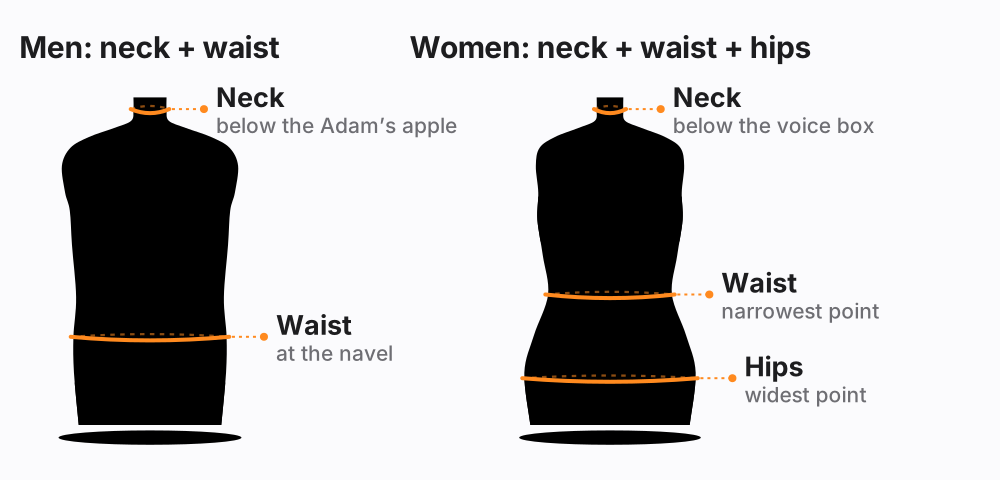
- Neck. Wrap the tape just below the larynx (Adam's apple), with the tape sloping slightly downward toward the front. Look straight ahead and keep your shoulders relaxed, not hunched.
- Waist. Men: a level loop around the abdomen at the navel. Women: a level loop at the narrowest point of the waist, usually a little above the navel. Stand relaxed and read the tape at the end of a normal breath out; don't suck in.
- Hips (women). Stand with feet together and measure around the widest part of the seat, keeping the tape parallel to the floor.
- Height. Barefoot, back against a wall, looking straight ahead.
- Repeat. Take each measurement twice and use the average. Snug on bare skin, not compressing it.
Use a flexible, non-stretch tape; old fabric tapes stretch.
What your result means
The calculator places your estimate in the American Council on Exercise (ACE) body fat categories. They describe typical ranges, not health diagnoses, and don't adjust for age.
| Category | Women | Men |
|---|---|---|
| Essential fat | 10–13% | 2–5% |
| Athletes | 14–20% | 6–13% |
| Fitness | 21–24% | 14–17% |
| Average | 25–31% | 18–24% |
| Obese | 32%+ | 25%+ |
Source: American Council on Exercise body fat norms. ACE describes 25–31% for women and 18–24% for men as typical for the average non-athlete (ACE).
Women's ranges sit higher because women carry more essential fat, which supports hormones and reproduction. Essential fat is the floor the body needs to function, not a goal. If a tape estimate puts you there, a measuring slip is more likely than a real reading.
Age matters too. Body fat tends to rise with age even at a stable weight, and research that linked body fat to healthy BMI ranges suggests roughly 8–19% for men and 21–32% for women aged 20–39, rising to about 11–21% and 23–33% at 40–59 (Gallagher et al., American Journal of Clinical Nutrition, 2000). Those ranges also differ by ethnicity, so treat any chart as context, not a verdict. To see what these numbers tend to look like, our guide to body fat percentage pictures walks through each range for men and women.
How accurate is a body fat calculator?
On average, tape methods land in the right neighborhood. For any one person they can be off by a lot.
- The Navy method. A 2024 study in Military Medicine compared the military's neck-waist(-hip) tape method with DXA scans. For women it was close on average (about 1.7 points low), but individual results ranged from roughly 14 points under to 11 points over; for men it read about 5.5 points low on average (Combest et al., 2024). A study of fit US Marines found the same pattern with a newer waist-only tape equation: lean people tended to be overestimated and people with more body fat underestimated (Potter et al., Frontiers in Physiology, 2022). That's why the result shows a shaded band, not just a single point.
- The BMI method. Deurenberg's formula had a standard error of about 4.1 points and slightly overestimated body fat in people with obesity. It also misreads muscular people, who are heavy for their height without being fat.
- Everything else is an estimate too. DXA is the closest most people can book, smart scales swing with hydration, and calipers depend on the tester. Different methods disagree, so pick one and stick to it.
If the Navy and BMI estimates disagree by five points, neither is wrong. They're different shortcuts to the same unknown.
Track the trend, not one number
A single reading tells you where you roughly are. Repeated readings, taken the same way, tell you which direction you're going, and that's what actually answers "is this working?"
- Measure on the same schedule. Every two to four weeks is plenty; body fat doesn't change meaningfully day to day. Morning, before eating, after the bathroom is the most repeatable.
- Watch your waist on its own. If the waist is coming down while neck and weight hold steady, you're losing fat, whatever the formula says.
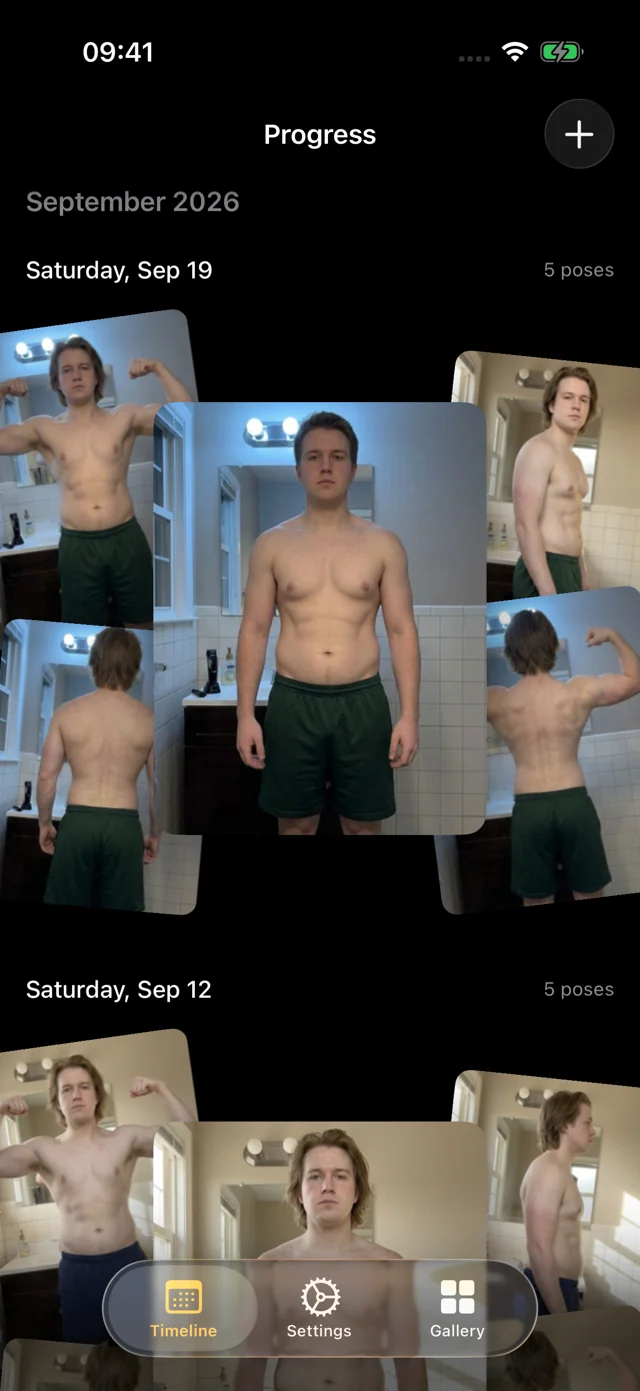
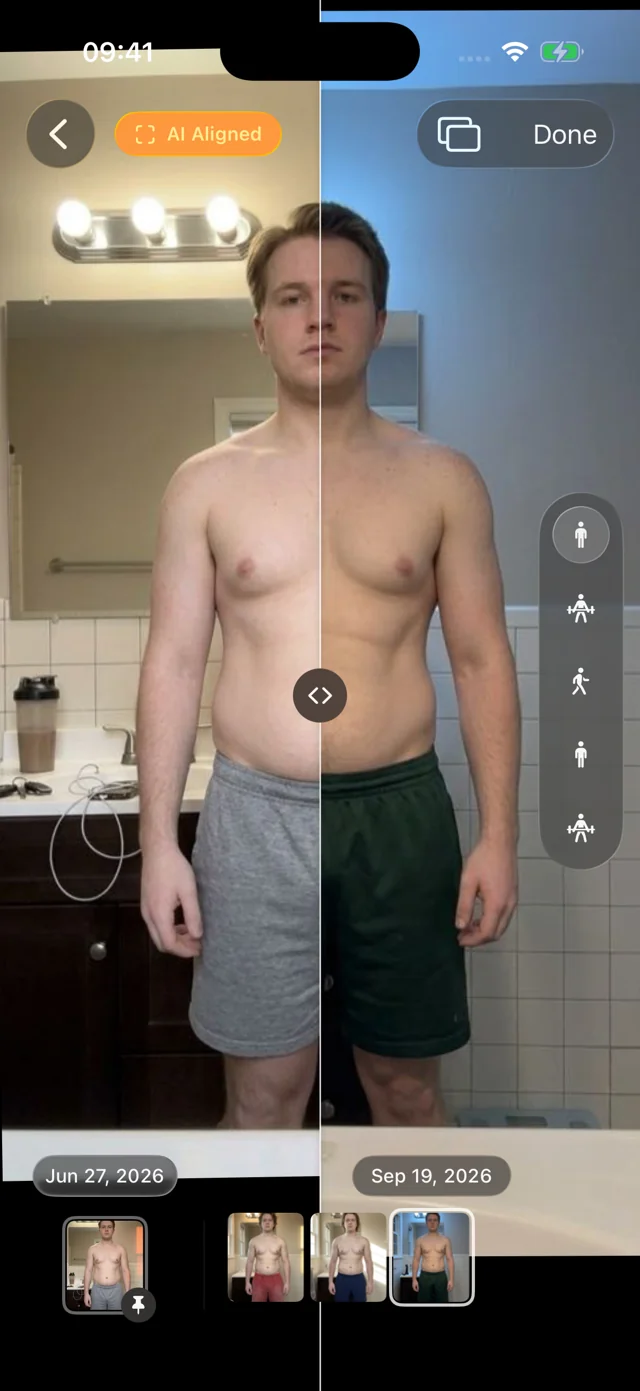
- Pair the tape with photos. A tape can't show where change happens; photos can. Take them in the same spot, light and poses each time, then compare checkpoints weeks apart. Our guide to taking progress photos that actually show change covers the setup.
- Expect noise. Water, food and the menstrual cycle move both the tape and the mirror. If the scale stalls, read why a weight loss plateau is often just noise before changing your plan.
If you'd rather not fiddle with framing, Progress is a free iPhone app that keeps your progress photos AI aligned on your device, so the same pose from different weeks lines up for a fair side-by-side.
FAQ
How do I calculate my percent body fat?
The simplest at-home method is the US Navy formula above: measure your neck and waist (plus hips for women) and height, then enter them in the calculator. It uses logarithms, so a calculator is easier than doing it by hand. For a more precise number, a DXA scan is the closest to a reference most people can book.
What should my body fat be for my age?
There's no single right number. As a rough guide from research that matched body fat to healthy BMI ranges, about 8–19% for men and 21–32% for women aged 20–39, and about 11–21% and 23–33% at 40–59, is common. A clinician can put your number in context with waist size, fitness, blood pressure and blood work.
Is 18% body fat chubby?
For a man, 18% is the lower edge of ACE's "average" range: a smooth, mostly flat stomach with little visible ab definition is typical. For a woman, 18% is in the "athletes" range and is quite lean. How it looks depends heavily on lighting, muscle and where you store fat.
Is 200 lbs overweight for 5'8"?
At 5'8" (68 inches) and 200 lb, BMI is about 30.4, which the CDC classes as obesity (30 or greater). BMI is a screening measure, though: a muscular person can be heavy for their height without much body fat. A waist and neck measurement in this calculator gives a better picture than weight alone (CDC adult BMI categories).
Is the Navy body fat calculator accurate?
For groups, it's within a few points of lab methods on average. For an individual, it can be off by more, especially at the very lean and very high ends. It's most useful for tracking your own change with the same tape and technique over time.