Progress
Army Body Fat Calculator (2026 Waist-to-Height Standard)
Army body fat calculator updated for the 2026 waist-to-height standard. See your WHtR the way the Army records it, the largest waist that passes, and the old tape test.
The Army no longer grades body fat percentage. Since July 7, 2026, Army Directive 2026-13 has used a single test: your waist at the navel divided by your height. Under 0.550 meets the standard. This Army body fat calculator applies the Army's own rounding rules, so you see the number that would go on DA Form 5500, plus the largest waist that passes at your height.
The calculator needs JavaScript. You can work it out by hand:
- Measure your height in socks and round to the nearest half inch.
- Measure your waist at the navel three times, tape level. Round each reading down to the half inch and average them.
- Divide waist by height and keep three decimals without rounding up (0.5499 is 0.549).
Less than 0.550 meets the Army standard. At 70 inches tall, that means a recorded waist of 38 inches or less.
Key takeaways
- The Army standard is now a waist-to-height ratio (WHtR) under 0.550. There's no age or sex adjustment and no body fat percentage.
- Height is rounded to the nearest half inch. Each waist reading is rounded down to the half inch, and the ratio is cut, not rounded, to three decimals.
- The tape test, height and weight tables, DXA or InBody challenges and the AFT 465 exemption were all rescinded.
- A rough rule: your waist at the navel must stay under 55% of your height.
How the Army body fat test works in 2026
In January 2026, the Department of Defense told every service to judge body composition by waist-to-height ratio, with an upper limit of less than 0.55 (Under Secretary memo, January 12, 2026). The Army followed with Army Directive 2026-13, announced July 7, 2026. It made WHtR the Army Body Composition Program's sole assessment for the Regular Army, Guard, Reserve, and USMA and ROTC cadets (army.mil).
What changed for Soldiers:
- One number for everyone. No age groups, no male and female tables. A 19-year-old and a 45-year-old of the same height have the same maximum waist.
- No weight on the form. The height and weight screening tables are gone, and DA Form 5501 is retired.
- No second opinion from another method. The tape test is rescinded, and the Army's FAQ says Soldiers can't request a tape test, DXA, InBody or Bod Pod to challenge a WHtR result.
- No fitness exemption. The AFT exemption for scoring 465 or more with at least 80 points per event (AD 2025-17, September 2025) was rescinded. So was the older ACFT 540 exemption. Fitness scores no longer excuse anyone from the standard.
- A same-day recheck. A result of 0.550 or higher triggers a confirmation measurement by a different team on the same duty day. Only a confirmed result leads to a flag and enrollment in the ABCP. Active-component Soldiers then get a commander-directed medical exam, and no one will be separated for WHtR until the 180-day review is finished.
Pregnancy and postpartum exemptions still apply. Units must leave at least seven days between a Soldier's AFT or CFT and their WHtR screening.
How the Army measures height and waist
The procedure comes from HQDA EXORD 182-26, Annex A. Two trained NCOs, or DA civilians, do the measuring, ideally of the same sex as the Soldier. One places the tape and the other checks it and records. You stand in socks, PT shorts and a T-shirt. The shirt can come off or be tucked up into the collar, but shapewear and binding undergarments aren't allowed.
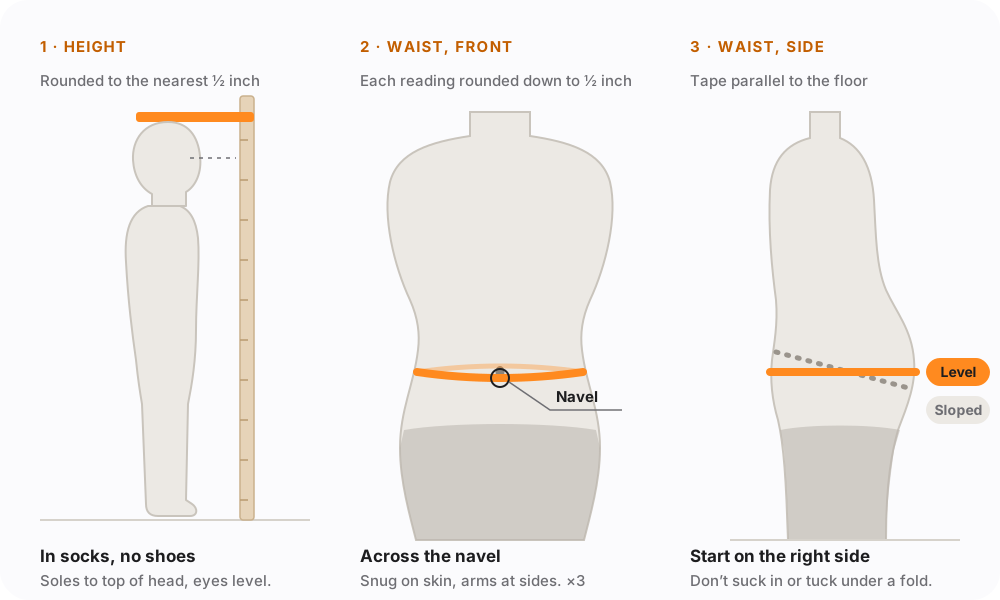
- Height. In socks, on a flat surface, head level and eyes forward, standing as at attention but not rigid. It's measured from the soles of the feet to the top of the head and rounded to the nearest half inch: 69.3 inches is recorded as 69.5.
- Waist. Arms hang naturally. The tape goes around the abdomen at the navel, starting on your right side and staying parallel to the floor. It sits on skin and follows the body without squeezing it.
- Three readings. Each one is rounded down to the nearest half inch, so 37.9 inches goes on the form as 37.5. If one is more than an inch off the others, a fourth reading is taken and the three closest are averaged to the nearest half inch.
- The ratio. The average waist is divided by height and recorded to three decimals with everything after the third digit dropped. The Army's own example: 0.549888 is recorded as 0.549 and meets the standard. 0.550 doesn't.
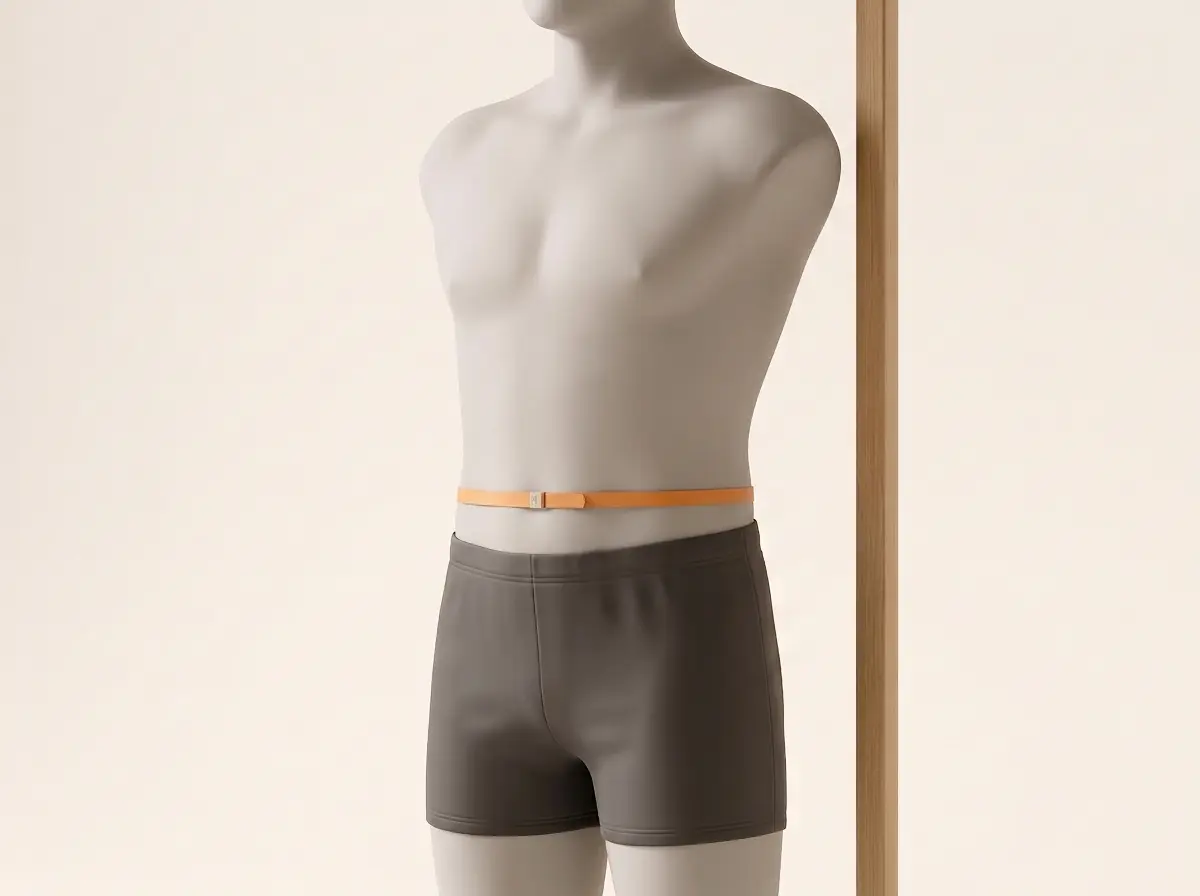
The Army specifies the tape, too: non-stretch fiberglass, a quarter to a half inch wide, checked against a ruler before use. Cloth tapes stretch and steel tapes don't follow the body. If a skin fold hides the navel, the measurer marks where the navel sits on the outside of the fold and tapes over that mark. Measuring under the fold would undercount. With no navel, the reference point is 2 inches above the hip bone (the anterior superior iliac spine).
Why the rounding matters
Rounding each reading down works in your favor, by up to just under half an inch per reading. Truncating the ratio does too. Height rounds both ways. Near the line, these rules can decide the outcome, so the calculator shows each step.
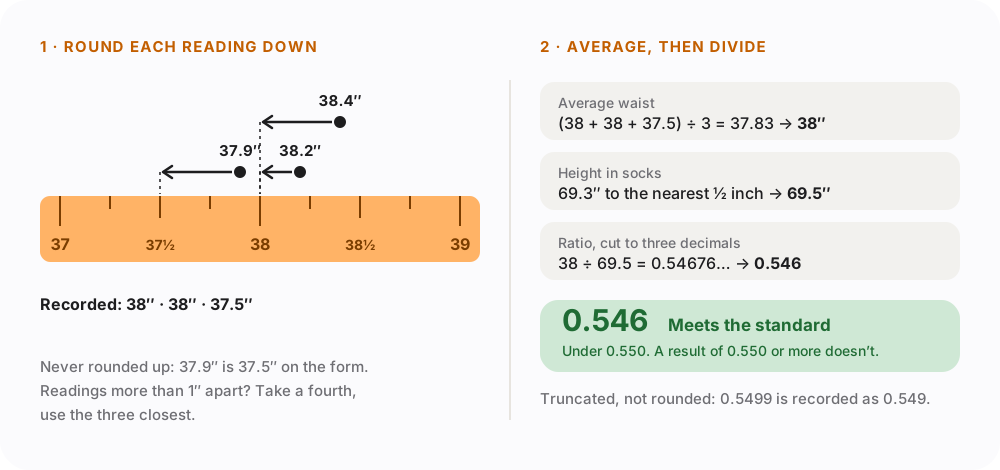
Annex A averages the three readings "to the nearest half inch"; the DA Form 5500 instructions just say "divide the average." The two usually agree. When they don't, the calculator flags the result as borderline and shows both.
Army height and waist chart
The Annex A screening table lists the largest waist that meets the standard at each half-inch height, from 48 to 83.5 inches. The calculator matches it row for row.
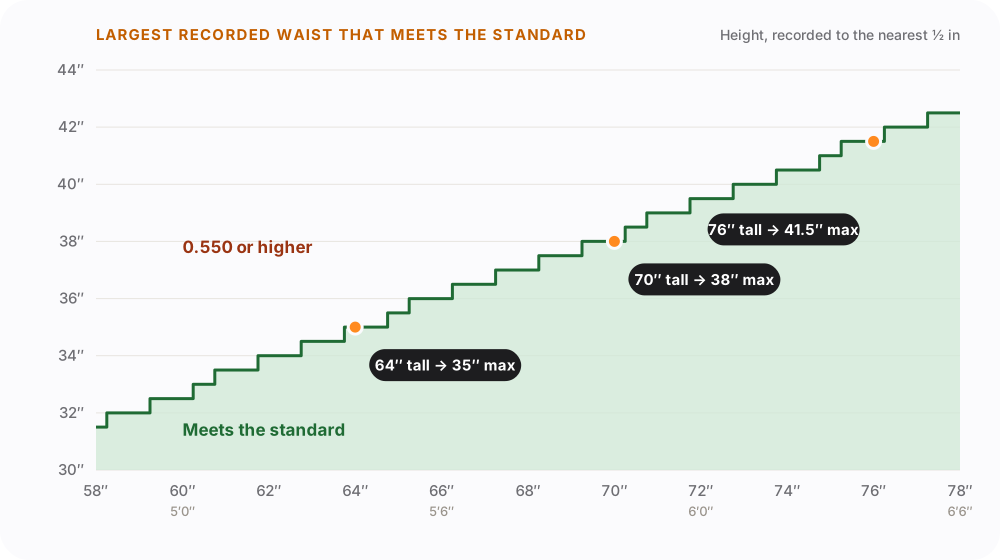
| Height | Max waist | Height | Max waist | Height | Max waist |
|---|---|---|---|---|---|
| 60″ (5′0″) | 32.5″ | 66″ (5′6″) | 36″ | 72″ (6′0″) | 39.5″ |
| 61″ | 33.5″ | 67″ | 36.5″ | 73″ | 40″ |
| 62″ | 34″ | 68″ | 37″ | 74″ | 40.5″ |
| 63″ | 34.5″ | 69″ | 37.5″ | 75″ | 41″ |
| 64″ | 35″ | 70″ | 38″ | 76″ | 41.5″ |
| 65″ | 35.5″ | 71″ | 39″ | 77″ | 42″ |
Recorded values: height rounded to the nearest half inch, waist rounded down to the half inch. For the full table, see Figure B–1 in Annex A.
The old Army tape test (2023 to 2026)
The calculator keeps the previous method as a second mode. Army Directive 2023-11 replaced the old neck-and-waist (and hip) tape with a one-site test: weight plus abdominal circumference at the navel. The equations from ALARACT 046/2023, Table B–5, take weight in pounds and abdomen in inches:
| Formula (percent body fat) | |
|---|---|
| Men | −26.97 − (0.12 × weight) + (1.99 × abdomen) |
| Women | −9.15 − (0.015 × weight) + (1.27 × abdomen) |
Results were rounded to the nearest whole percent and compared with age-based maximums: men 20%, 22%, 24% and 26%, and women 30%, 32%, 34% and 36%, for ages 17–20, 21–27, 28–39 and 40 and older. The Army's worked examples: a 210 lb man with a 35-inch abdomen comes to 17.48%, recorded as 17%. A 165 lb woman with a 30-inch abdomen comes to 26.475%, recorded as 26%.
What your result means, and what it doesn't
The Army chose WHtR as a health screen. Large studies back the idea: in a meta-analysis of studies covering more than 300,000 adults, waist-to-height ratio flagged cardiometabolic risk better than BMI or waist size alone (Ashwell et al., Obesity Reviews, 2012). In civilian health guidance, the line is lower. The UK's NICE treats 0.5 to 0.59 as increased central fat and 0.6 or above as high. So a WHtR of 0.53 meets the Army standard but sits above the "keep your waist under half your height" health guidance. The dashed 0.5 mark on the calculator's gauge shows that difference. Our waist-to-height ratio calculator uses the NICE bands.
Two limits:
- It's a screen, not a body fat measurement. WHtR doesn't know how much of your waist is muscle, organ or fat. A thick, muscular trunk can push it up.
- Small errors move it. At 70 inches, the gap between 0.542 and 0.550 is half an inch of tape. Bloating, a big meal or a sloppy tape can change the result. Measure the same way every time.
Getting under the line
Waist circumference responds to the same things as body fat: a modest, sustained calorie deficit, enough protein, strength training and sleep. Expect slow, steady change, not a week of crash dieting before a screening. If you're enrolled in the ABCP, use the Army's medical evaluation and dietitian resources. Pregnancy, medications and medical conditions all affect waist size.
Track the trend, not single readings:
- Tape every two weeks. Morning, after the bathroom, before eating, at the end of a normal breath out, in front of a mirror to keep the tape level. Round each reading down, like the Army does.
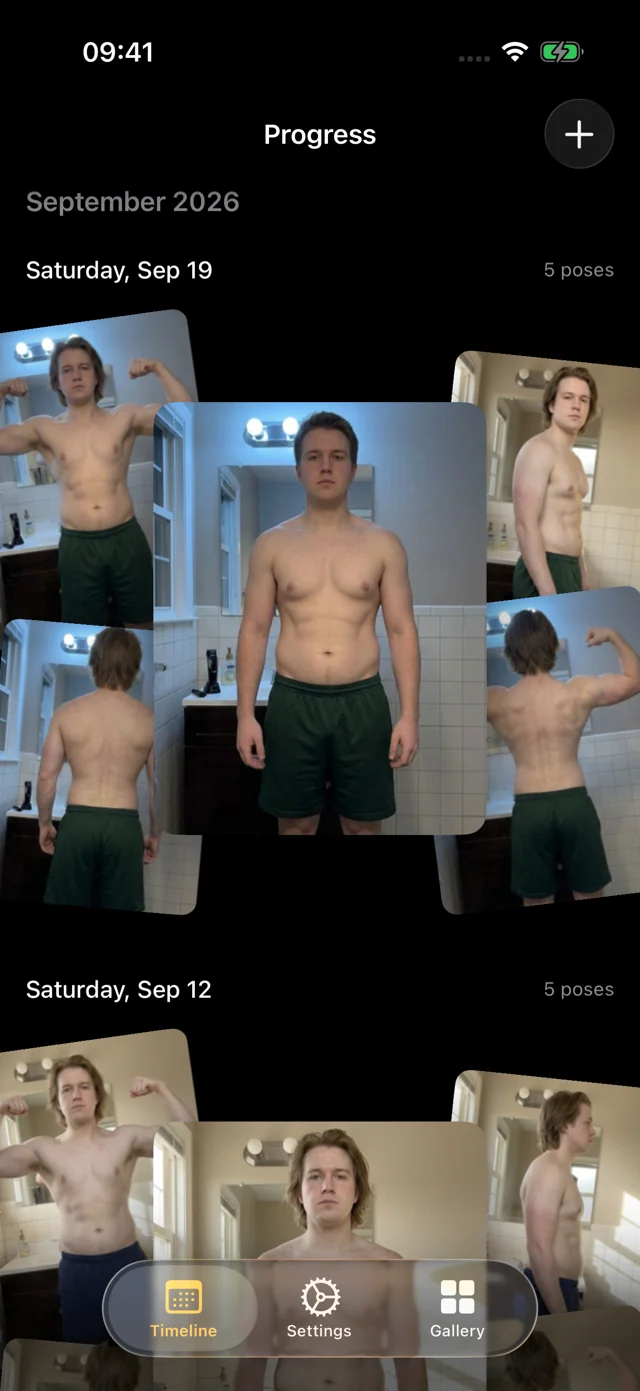
- Pair it with photos. The tape tells you how much; photos show where. Take them in the same spot, light and poses each time. Our guide to taking progress photos that show change covers the setup, and body fat percentage pictures shows what different ranges tend to look like.
- Don't panic over plateaus. Water and food move both the scale and the tape day to day. See why a weight loss plateau is often just noise.
Progress is a free iPhone and iPad app that keeps progress photos AI aligned, so the same pose from different weeks lines up for an honest side-by-side, with your weight alongside each session.
FAQ
What is the new Army body fat standard?
As of July 7, 2026, it's a waist-to-height ratio under 0.550 for all Soldiers, regardless of age or sex (Army Directive 2026-13). Waist is measured at the navel and divided by height, both in inches. Body fat percentage, the tape test and the height and weight tables are no longer used.
How do I calculate my Army body fat?
Under the current rules you calculate a ratio, not a percentage. Round your height to the nearest half inch. Take three waist readings at the navel, round each down to the half inch and average them. Divide the waist by the height and keep three decimals without rounding up. The calculator above does all of this and shows each step.
What's the maximum waist for my height in the Army?
Multiply your height by 0.55. The largest recorded waist that passes is the half inch just below that number. At 5′6″ (66 inches) that's 36 inches, at 5′10″ (70 inches) 38 inches, and at 6′0″ (72 inches) 39.5 inches. See the chart above or enter your height in the calculator.
Does a high AFT score still exempt you from the tape test?
No. The exemption for scoring 465 or more on the AFT (AD 2025-17) and the earlier ACFT 540 exemption were rescinded by AD 2026-13. No fitness score exempts a Soldier from the WHtR standard.
Can I challenge a WHtR result with a DXA scan or InBody?
No. Supplemental body fat assessments were rescinded along with the tape test. What you get instead is a confirmation measurement by a different team on the same duty day, before any action is taken.
What were the Army body fat percentages by age?
Under the rescinded 2023 rules, the maximums were 20% (ages 17–20), 22% (21–27), 24% (28–39) and 26% (40+) for men, and 30%, 32%, 34% and 36% for women. They no longer apply to serving Soldiers. Enlistment (accession) standards are set separately, so recruits should check the current requirements with a recruiter.