Progress
Waist to Hip Ratio Calculator with WHO Cut-offs by Sex
Free waist to hip ratio calculator. Compare your WHR with WHO cut-offs of 0.85 for women and 0.90 for men, see your shape, and learn where to place the tape.
Enter your waist and hip measurements to get your waist-to-hip ratio (WHR) and see how it compares with the World Health Organization's cut-offs for women and men. Results update as you type.
Waist-to-hip ratio = waist ÷ hips, both in the same units. Example: a 30 in waist and 40 in hips give 30 ÷ 40 = 0.75.
WHO cut-offs for substantially increased risk of metabolic complications: 0.85 or more for women and 0.90 or more for men.
Turn on JavaScript to use the interactive calculator.
How to calculate waist-to-hip ratio
WHR = waist circumference ÷ hip circumference
Measure both in the same units. Units cancel out, so 76 cm ÷ 102 cm and 30 in ÷ 40 in give the same answer, 0.75. The calculator cuts the result to two decimals instead of rounding, so 0.849 reads 0.84 and stays below the 0.85 cut-off.
The ratio describes where you carry fat, not how much. Two people with the same weight can have very different ratios: one carries more around the abdomen (a higher ratio), the other more around the hips and thighs (a lower ratio). Fat stored around the abdomen, including the visceral fat packed around the organs, is the type most closely linked with type 2 diabetes and heart disease, so your shape tells you something weight alone can't.
WHO cut-offs by sex
A World Health Organization expert consultation on waist circumference and waist–hip ratio (2008, published 2011) found that disease risk rises with both measures across diverse populations. Its cut-offs:
| Measure | Women | Men | Risk of metabolic complications |
|---|---|---|---|
| Waist-to-hip ratio | 0.85 or more | 0.90 or more | Substantially increased |
| Waist circumference | Over 80 cm (31.5 in) | Over 94 cm (37 in) | Increased |
| Waist circumference | Over 88 cm (34.6 in) | Over 102 cm (40.2 in) | Substantially increased |
Before you lean on these numbers:
- The ratio cut-offs differ by sex because women typically carry more fat on the hips and thighs, so the same ratio means something different. The calculator asks for your sex; without it, it shows both lines.
- WHO gives one threshold, not a ladder. Below the cut-off simply means below the level WHO links with substantially increased risk.
- They're based mostly on people of European descent. Optimal cut-offs vary between ethnic groups. Compared with Europeans, for example, Asian populations tend to carry more visceral fat at the same waist size, which argues for lower thresholds.
- The waist circumference values come from a Dutch study, not a WHO recommendation. The calculator shows them for context.
What is a good waist-to-hip ratio?
By the WHO cut-offs, a ratio below 0.85 for women and below 0.90 for men. There isn't an "ideal" number below that line: a ratio of 0.77, for instance, is under the cut-off for both sexes, and moving from 0.78 to 0.74 isn't a meaningful health goal on its own. If you're at or above the line, watch how your waist itself trends.
Your shape also changes over time. Waist and hip measurements change with age, and in women, menopause is associated with fat shifting toward the abdomen. A ratio that creeps up over the years is worth noticing even if your weight hasn't changed.
How to measure waist and hips
A waist-to-hip ratio is only as good as two tape placements. Do it standing, feet close together, arms at your sides, wearing little or nothing over the areas you measure.
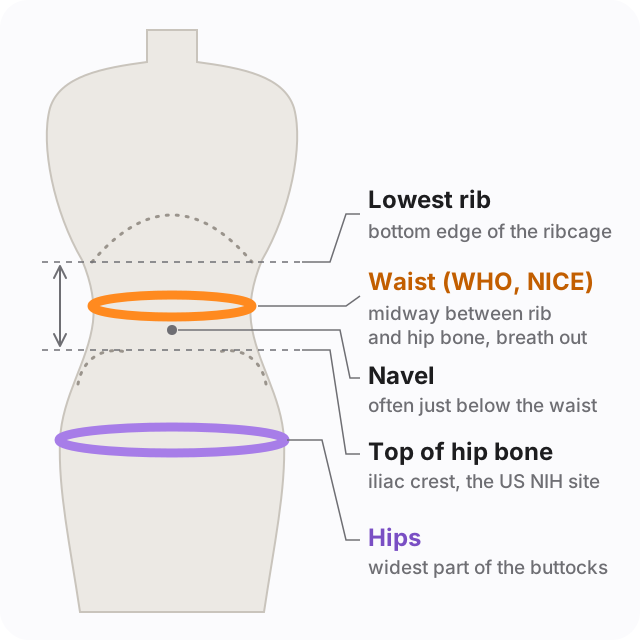
- Waist: find the midpoint. Feel for the bottom of your ribcage and the top of your hip bone at your side. Wrap the tape halfway between them, usually just above the belly button.
- Breathe out, then read. Take the reading at the end of a normal breath out, relaxed, without sucking in. The tape should be snug but not pressing in.
- Hips: find the widest point. Looking side-on in a mirror, slide the tape up and down over your buttocks until you find the largest measurement. Keep the tape level with the floor all the way round.
- Repeat both. Measure each twice and average the readings if they're within 1 cm (about ⅜ in); otherwise, measure again.
Midpoint, hip bone or navel?
The WHO STEPS protocol measures the waist at the midpoint between the lowest rib and the top of the hip bone (iliac crest), the same place NICE tells people to measure at home. The US NIH practical guide and the NHANES survey measure at the top of the hip bone, which sits lower. Some studies measure at the navel, which is easy to find but varies from person to person and can underestimate the true waist. For hips, all of them agree: the widest part of the buttocks.
Use the midpoint for comparing with the cut-offs above. For tracking yourself, stick to one method, and measure in the morning before eating, since a full stomach adds to the waist.
Waist-to-hip or waist-to-height?
Both describe central fat, and they answer slightly different questions:
- Waist-to-hip ratio describes shape: how your waist compares with your hips. It needs a sex-specific cut-off and two careful measurements. Hips are harder to measure well than the waist.
- Waist-to-height ratio compares your waist with your height. It has one cut-off, 0.5, for men and women, and needs only one tape measurement. Our waist-to-height ratio calculator uses the bands from the UK's NICE guideline.
For tracking progress, there's a catch with waist-to-hip ratio: if you lose fat from your waist and hips at the same time, the ratio can barely move even though both measurements dropped. A shrinking waist with a flat ratio is still progress, so record the raw waist and hip numbers, not only the ratio.
Using your waist to track progress
Waist measurements are among the most useful non-scale markers you can track. A 2020 consensus statement in Nature Reviews Endocrinology argued that waist circumference should be treated as a vital sign, called reducing it a critically important treatment target, and noted that exercise- or diet-driven reductions in waist circumference "are observed with or without weight loss."
That explains a common, frustrating week: the scale doesn't move, but your jeans fit differently. Our guide to the weight loss plateau walks through how to tell a real stall from water weight using the tape and photos. If you're losing weight on a GLP-1 medication, GLP-1 progress photos covers tracking change that happens faster than the mirror can keep up with.
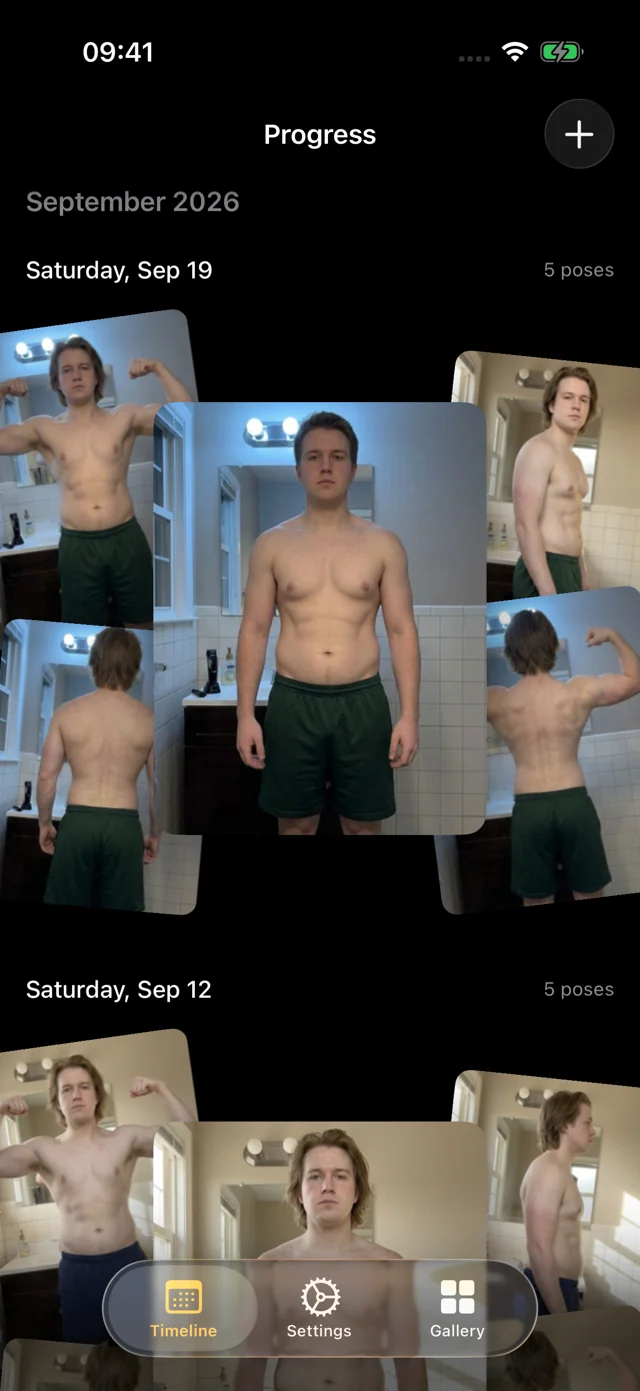
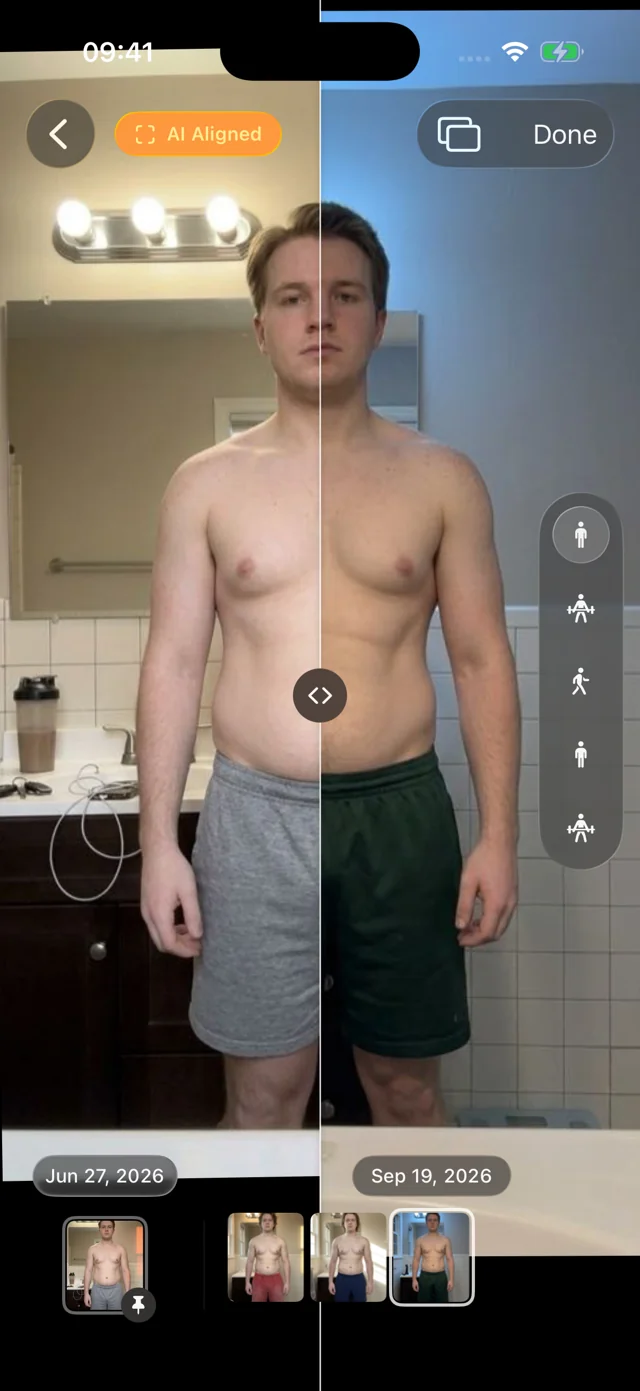
A tape gives you two circumferences; photos show where the change came from. If you take front and side photos at each check-in, Progress lines them up automatically with on-device AI so you can compare your waistline week to week without guessing at the framing. For the setup itself, see how to take progress photos.
FAQ
What is a good hip to waist ratio?
By WHO's cut-offs, a waist-to-hip ratio below 0.85 for women and below 0.90 for men. At or above those values, WHO links the ratio with a substantially increased risk of metabolic complications such as type 2 diabetes. (People often say "hip to waist", but the ratio is always waist divided by hips.)
How do I calculate my waist-to-hip ratio?
Measure your waist midway between your lowest rib and the top of your hip bone, and your hips around the widest part of your buttocks, in the same units. Divide waist by hips. For example, 32 in ÷ 40 in = 0.80.
Is a waist-to-hip ratio of 77% considered good?
A ratio of 0.77 (77%) is below WHO's cut-off for both women (0.85) and men (0.90), so it isn't in the range WHO links with substantially increased risk. It's one input, not a full health assessment.
What should my waist be at 5'7"?
Waist-to-hip ratio doesn't use height, so it can't answer that by itself; the waist that keeps you under the WHO cut-off depends on your hips (under 0.85 × hips for women, 0.90 × hips for men). Using height instead, the NICE guidance is to keep your waist under half your height: under 33.5 inches at 5 ft 7 in. The waist-to-height ratio calculator works it out for any height.
Is waist-to-hip ratio more accurate than BMI?
They measure different things. BMI reflects total size relative to height; waist-to-hip ratio reflects where fat is carried. Waist measures add information BMI misses, and many researchers use both. Neither directly measures body fat.