Progress
Lean Body Mass Calculator: Boer, James and Hume Compared
Free lean body mass calculator that runs the Boer, James and Hume formulas side by side, adds your body fat if known, and shows where each one breaks down.
This lean body mass calculator estimates how much of your weight is everything except fat. Instead of one number from one formula, it runs the three standard height-and-weight equations (Boer, James and Hume) side by side, adds a fourth estimate from your body fat percentage if you know it, and charts where they agree and where they drift apart.
It runs in your browser, and the page link keeps your inputs so you can come back to them.
Lean body mass formulas (weight W in kg, height H in cm):
Boer (1984). Men: 0.407W + 0.267H − 19.2. Women: 0.252W + 0.473H − 48.3.
James (1976). Men: 1.1W − 128(W/H)². Women: 1.07W − 148(W/H)².
Hume (1966). Men: 0.32810W + 0.33929H − 29.5336. Women: 0.29569W + 0.41813H − 43.2933.
From body fat: LBM = W × (1 − body fat % ÷ 100). Example: a 5′10″ man at 180 lb gets about 136 lb (Boer), 138 lb (James) and 127 lb (Hume). Turn on JavaScript to use the interactive calculator.
Key takeaways
- Lean body mass is your weight minus your fat mass: muscle, water, organs, bone and skin.
- The Boer, James and Hume formulas use only height, weight and sex, so they can’t tell a lifter from a non-lifter.
- They usually land within about 10 lb of each other; James breaks down at very high BMI.
- If you know your body fat percentage, that estimate is the one that reflects your own body.
What is lean body mass?
Lean body mass (LBM) is the part of your body weight that isn’t fat. It includes skeletal muscle, but also water, organs, bone, skin and connective tissue. If you weigh 180 lb and 18% of that is fat, your lean body mass is about 148 lb.
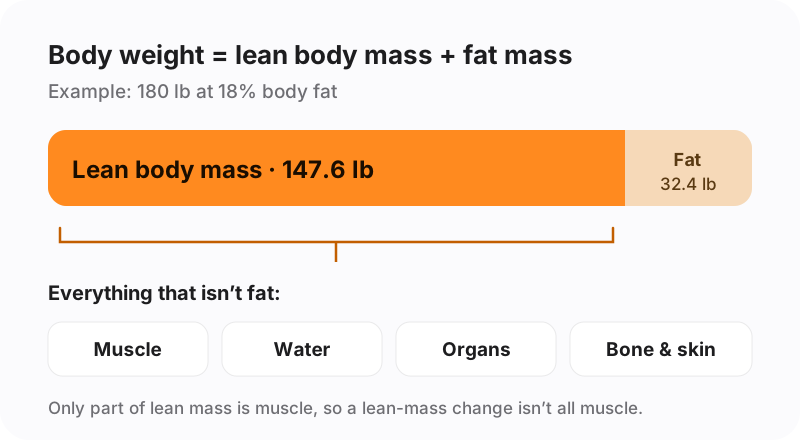
You’ll also see the term fat-free mass. Strictly, lean body mass includes a small amount of essential fat inside organs and cell membranes, while fat-free mass excludes all of it. The difference is smaller than any formula’s error, so the calculator treats them as the same.
Lean mass is used to scale drug doses and contrast dye in medicine, to set protein targets in nutrition, and as the input to the FFMI calculator, which turns lean mass into a muscularity score for your height.
The lean body mass formulas
Each equation came from a different group of people measured a different way, which is why they disagree. Weight (W) is in kilograms and height (H) in centimeters; the calculator converts US units for you.
| Formula | Men | Women |
|---|---|---|
| Boer (1984) | 0.407W + 0.267H − 19.2 | 0.252W + 0.473H − 48.3 |
| James (1976) | 1.1W − 128 × (W/H)² | 1.07W − 148 × (W/H)² |
| Hume (1966) | 0.32810W + 0.33929H − 29.5336 | 0.29569W + 0.41813H − 43.2933 |
| From body fat | W × (1 − BF% ÷ 100) | W × (1 − BF% ÷ 100) |
Coefficients as reprinted in Caruso et al. (2018).
Boer
Boer (1984) used estimated lean body mass to normalize blood and fluid volumes in 66 healthy adults. It’s a straight-line equation, so it keeps rising steadily with weight, and it’s often preferred over James in people with higher body weight.
James
The James equation comes from a 1976 UK government report on obesity and has been widely used in pharmacology. Its squared term makes it curve: past a certain BMI it predicts less lean mass as weight rises, which can’t be right. The curve peaks at a BMI of about 43 for men and 36 for women. The calculator flags James and drops it from the average as you approach that point.
Hume
Hume (1966) measured total body water in 29 men and 27 women and fitted equations to height and weight. The fit was strong for men (r = 0.96) and looser for women (r = 0.83). For people of average build it often gives the lowest estimate of the three.
From your body fat percentage
If you know your body fat percentage, multiply your weight by the lean fraction. This is the only estimate that reflects your body rather than the average person your size, but it inherits all the error of the body fat number. A tape-measure body fat estimate, a smart scale or a DXA scan will each give a different answer; pick one method and keep using it.
Which formula is most accurate?
None of them is accurate for everyone, because none of them knows how muscular you are. Two people at 5′10″ and 180 lb get identical results from Boer, James and Hume, even if one deadlifts 500 lb and the other has never trained.
As a rule of thumb:
- For a typical adult, the three formulas usually agree within about 5 kg (10 lb). Averaging them, as the calculator does, smooths out each one’s quirks.
- At higher body weights, prefer Boer. James bends downward, and all the classic equations are inconsistent at the extremes of body size (Janmahasatian et al., 2005).
- If you lift, all three will likely underestimate you. Use a body fat–based estimate instead.
- If you’re tracking change, the formulas are useless: they only move when your weight moves, and they assume every pound you gain or lose has the same lean/fat split. Track body fat with one consistent method, or track the result directly with photos.
The calculator’s chart plots each formula’s lean mass at your height across a range of body weights: where the lines bunch together, the estimates agree; where James peels away, you’re in territory it wasn’t built for.
How to use your lean body mass
- Check your muscularity. Divide lean mass by height squared to get your fat-free mass index. The FFMI calculator does this and shows typical ranges.
- Set a protein target. Many lifters base protein on lean mass rather than total weight, which avoids overshooting when body fat is high. A dietitian can tailor this to you.
- Track the trend, not the number. Recalculate every 8–12 weeks with the same body fat method, in the same conditions, at the same time of day.
Seeing lean mass change
Lean mass grows slowly. Even with good training, a few pounds of muscle over several months is a strong result, and that’s smaller than the day-to-day swing in water weight. A body fat estimate that moves two points between Monday and Thursday can hide a real gain entirely.
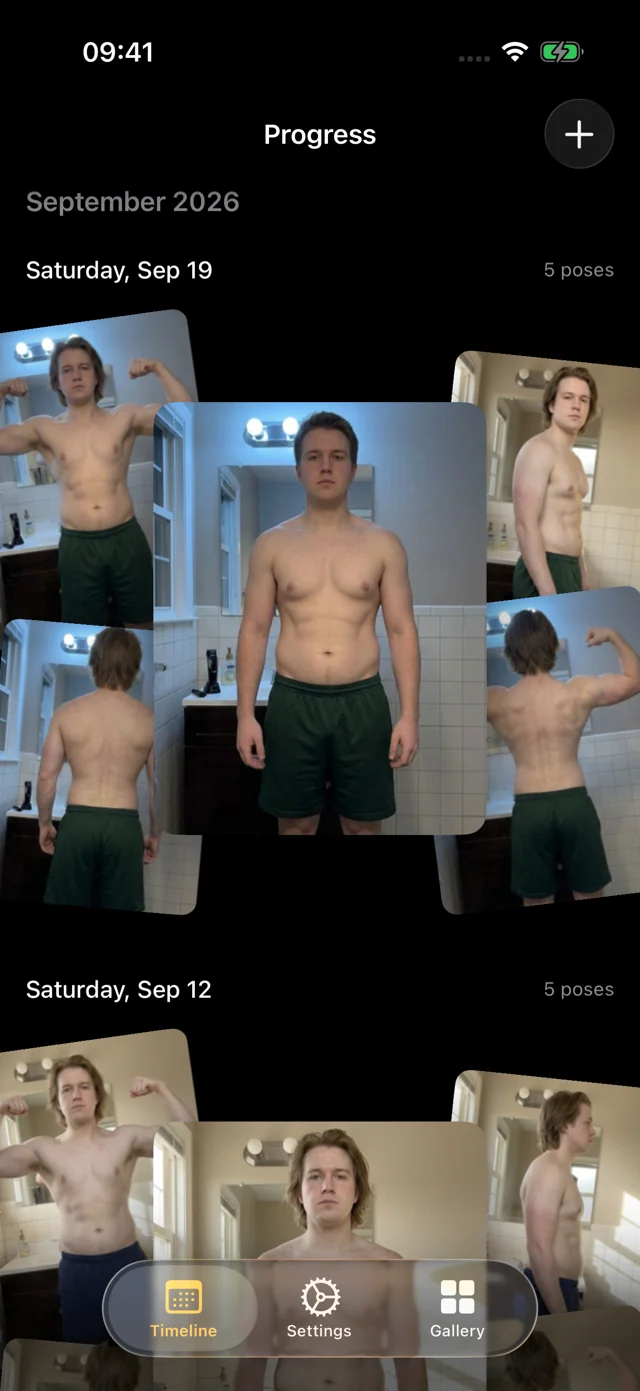
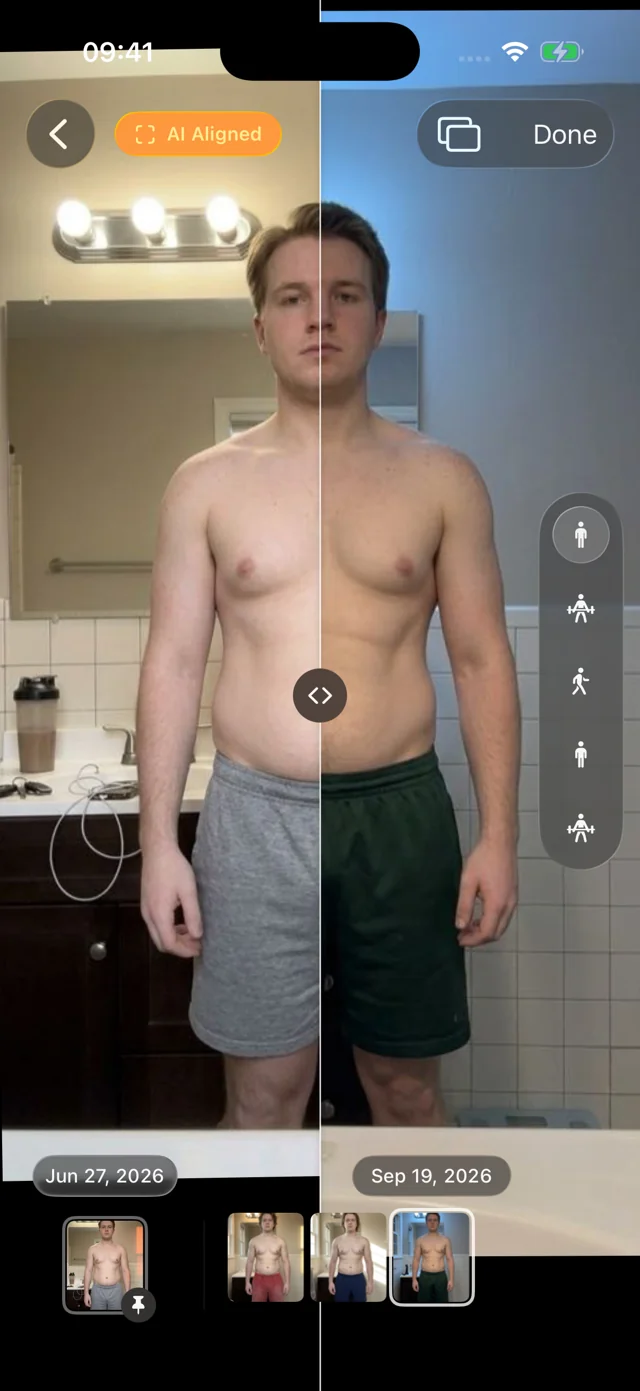
Photos fill that gap. When your weight is flat but your shoulders fill out and your waist tightens, that’s body recomposition, and consistent progress photos show it long before a formula does. See body recomposition before and after for what that looks like, the body transformation timeline for realistic pacing, and how to take progress photos for a setup you can repeat.
Progress handles the repeatable part: it captures five standard poses hands-free in about a minute, and every photo is AI aligned so you can slide between any two dates and compare like for like, privately on your phone.
FAQ
How do I calculate my lean mass?
Without a body fat measurement, use a height-and-weight formula like Boer: for men, 0.407 × weight (kg) + 0.267 × height (cm) − 19.2. If you know your body fat percentage, multiply your weight by (1 − body fat ÷ 100). The calculator above runs all of them at once.
Is 75% lean body mass good?
Seventy-five percent lean means 25% body fat. Whether that’s a good number depends heavily on sex, because women carry more essential fat than men, and on age and goals. Compare yourself with body fat percentage pictures, and talk to a clinician if you’re concerned about your health.
Is 20% body fat lean?
At 20% body fat you’re 80% lean. For many women that’s a lean, athletic level; for many men it’s closer to average. Visible definition also depends on where you store fat and how much muscle you carry.
What’s the difference between lean body mass and muscle mass?
Muscle is only part of lean body mass. Lean mass also includes water, organs, bone and skin, so a change in lean mass isn’t all muscle. Water shifts from carbs, salt or creatine can move it by a few pounds without any change in muscle.